Photo by Matthew Bornhorst on Unsplash
Powers
The U.S. Congress consists of the Senate and House of Representatives. The two chambers have some similarities in function and their own special powers
Shared Powers
| Power | Description |
|---|---|
| Legislative Power | All bills must pass both chambers before being sent to the President for signature into law |
| Budget Power | Review and pass the federal government budget |
| Executive Branch Oversight | Conduct investigation and oversight of the Executive Branch |
| War Declaration Power | Only Congress has the power to declare war |
Senate Special Powers
Number: 100 people
| Power | Description |
|---|---|
| Treaty Approval | International treaties must be approved by 2/3 majority of the Senate to take effect |
| Appointment Confirmation Power | Presidential nominations for senior officials and judges must be confirmed by the Senate |
| Impeachment Trial Power | Conduct trials for officials impeached by the House of Representatives |
House Special Powers
Number: 435 people
| Power | Description |
|---|---|
| Tax Bill Introduction | All bills involving taxation must originate in the House of Representatives |
| Impeachment Introduction | Only the House of Representatives has the power to impeach federal officials |
| Presidential Election | When the Electoral College fails to elect a president, the House of Representatives elects the president |
Chamber Size and Term Structure Differences
| House of Representatives | Senate | |
|---|---|---|
| Size | 435 | 100 |
| Term | 2 years | 6 years |
| Description | Seats allocated based on state population proportion | 2 per state, balancing interests of large and small states |
| Election Frequency | 2 years | 2 years |
| Number of Seats Up for Election | 435 | 1/3 of seats (about 33-34 seats) |
| Election Mechanism | Reflects public opinion changes | Through staggered terms, ensures 2/3 senior members remain in the Senate, helping maintain policy continuity and institutional stability |
| Qualification Requirements | At least 25 years old, U.S. citizen for at least 7 years | At least 30 years old, U.S. citizen for at least 9 years |
House and Senate Leadership Structure
Senate
Number: 100 people
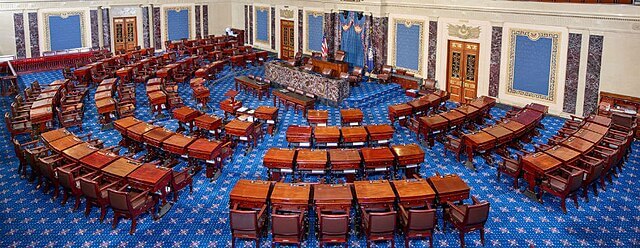
By United States Senate - https://www.senate.gov/index.htm, Public Domain, Link
| Item | Description |
|---|---|
| Nominal Leader | Vice President of the United States, but rarely presides over meetings |
| Actual Daily Meeting Chair | President pro tempore, usually the most senior Senator from the majority party |
| Voting Power of Leader | Leader has no vote except in case of a tie |
| Pro Tempore Election | Elected by full Senate, mainly responsible for presiding over meetings but with limited actual power |
| Real Power | Real power lies with Majority Leader and Minority Leader, elected by their respective party caucuses |
House of Representatives
Number: 435 people
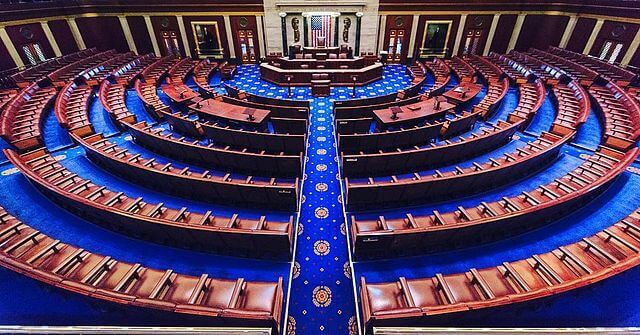
By United States House of Representatives or Office of the Speaker of the House - speaker.gov and Speak Paul Ryan on Facebook (direct link), Public Domain, Link

| Item | Description |
|---|---|
| House Speaker | Highest leader in the House of Representatives |
| Speaker Election | Elected by all House members, usually the majority party leader |
| Speaker Powers | Speaker has significant power, including setting agenda and appointing committee members |
| Other Leadership | Besides Speaker, includes Majority Leader and Minority Leader |
Power Comparison
| Item | House Speaker | Senate President Pro Tempore |
|---|---|---|
| Powers | Greater power, can control agenda and legislative process | Mainly a ceremonial role, real power held by party leaders |
| Presidential Succession Order | Second | Third |
The House leadership structure is more centralized, while the Senate is more dispersed, reflecting different design features and functions of the two chambers.
Common Questions
Is the Senate More Important or the House of Representatives?
The Senate and House of Representatives both play important roles in the U.S. political system, each with unique powers and influence
Senate’s Importance
Number: 100 people
| Item | Description |
|---|---|
| Longer Terms | Senators serve 6-year terms, longer than Representatives’ 2-year terms, allowing them to focus more on long-term policy |
| Special Powers | Power to confirm presidential nominations for important officials and judges, and approve international treaties |
| Impeachment Trial Power | Serves as trial court in presidential impeachment cases |
| Representation | 2 Senators per state regardless of population, ensuring small states’ interests are represented |
| Prestige | Generally considered more prestigious than the House |
House’s Importance
Number: 435 people
| Item | Description |
|---|---|
| Direct Public Opinion | 435 members elected every 2 years, can quickly reflect voter wishes |
| Tax Bill Initiation | All bills involving taxation must originate in the House |
| Impeachment Power | Only the House can impeach federal officials |
| Presidential Election Power | When Electoral College fails to elect president, the House elects the president |
| Numerical Advantage | More members, broader representation |
Both chambers play key roles in the legislative process, bills must pass both chambers to become law. They represent public opinion in different ways and create checks and balances in the political system.
The Senate and House each have their importance and unique functions, together forming the complete U.S. Congressional system, making it difficult to say which is more important.
Their design aims to represent people’s interests in different ways and create checks and balances in the political system.
What are the reasons and rules for dividing Senators into three groups?
| Item | Description |
|---|---|
| Three Rotation Groups | The 100 Senators are divided into three groups of 33-34 people each. One group is re-elected every two years, completing a full election cycle over six years. |
| Historical Origin | This design dates back to the founding of the United States. The Constitution’s framers wanted to ensure the Senate’s stability and continuity, avoiding complete membership turnover in a single election. |
| Initial Grouping | When the Senate was established, senators were divided into three groups whose terms ended after two, four, and six years, with one group being re-elected every two years thereafter. |
| State Representation | Each state has two senators who are assigned to different election groups to ensure representation of each state in every election. |
| New States | When new states join the Union, their two senators are randomly assigned to the existing three groups to maintain overall balance. |
| Stability | Through this staggered term mechanism, the Senate always retains about 2/3 experienced senators, which helps maintain policy continuity and institutional stability. |
This design embodies the concept of “checks and balances” in the U.S. political system and aims to balance democracy and stability, short-term interests and long-term considerations.
By maintaining the continuity of some senators while regularly introducing new members, the Senate can achieve a balance between representing the people and protecting long-term national interests.
Why are there 100 Senators and 435 Representatives in the House, why not more or fewer?
The number of members in the Senate and House of Representatives is based on historical developments, constitutional provisions, and practical requirements.
Senate
- The establishment of 100 members comes from the constitutional provision that each state has 2 senators.
- This rule serves to balance large and small states and ensures equal representation for each state in the Senate.
- As the U.S. developed from originally 13 to now 50 states, the number of senators correspondingly increased to 100.
House of Representatives
- The establishment of 435 members was determined by the “Permanent Apportionment Act” of 1929.
- This number was based on population and political considerations at the time and was seen as an appropriate balance between representation and efficiency.
- The Constitution stipulates that House seats are distributed according to state population, with each state having at least one representative.
- The number 435 was deemed suitable to both ensure adequate representation and maintain a manageable size of the House.
Why Not More or Fewer
- More members could improve representation but would also increase operational costs and complexity.
- Fewer members could reduce representation, especially for less populous states.
- The current numbers are considered a balance between representation, efficiency, and practicality.
- Changing these numbers requires amending the law (House) or the Constitution (Senate), which is politically very difficult.
Are there currently states with only one representative? If so, how can the voices of unrepresented parties be heard?
According to the current House apportionment system, the following less populous states have only one representative:
- Alaska
- Delaware
- North Dakota
- South Dakota
- Vermont
- Wyoming
In these states with only one representative, there is indeed a problem of minority voices being difficult to represent directly at the federal level. However, there are several mechanisms that can partially alleviate this situation:
| Mechanism | Description |
|---|---|
| Senate Representation | Each state regardless of population has 2 senators who can represent different parties |
| State Politics | Minorities still have opportunities to speak and participate in state legislatures and gubernatorial elections |
| District Competition | Though there’s only one seat, different parties can still compete in the election process, forcing the elected to consider various voices |
| Media and Lobbying | Minorities can express their concerns through media and interest groups |
| Interstate Cooperation | Minorities can work with party colleagues from other states to indirectly influence |
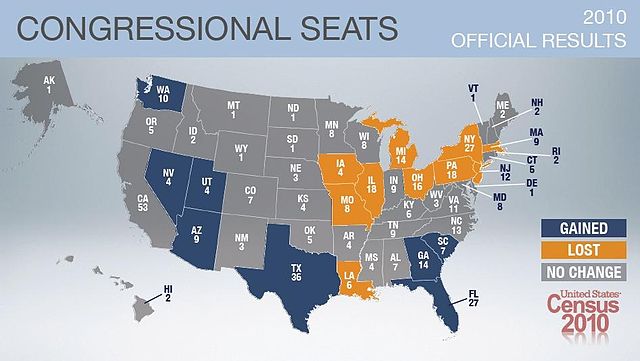
| Regular Reapportionment | The census every 10 years may lead to seat redistribution, offering opportunities for change |
Although a single representative may tend to represent their own party’s position, they also need to consider the diverse opinions of all voters in their district to ensure re-election.
Furthermore, the U.S. political system is designed to balance state rights and population representation. While this system has its flaws, it also has its justification.
Why can the Speaker of the House appoint committee members? How are committee members determined?
The Speaker’s appointment power for committee members is based on the following aspects
| Item | Description |
|---|---|
| Constitutional and Procedural Rule Authority | The U.S. Constitution and House rules grant the Speaker broad powers, including influence over committee personnel |
| Majority Party Leader Status | The House Speaker is usually the majority party leader, holding party personnel appointment power |
| Historical Tradition | Long-established practice gives the Speaker important say in committee personnel arrangements |
Committee Member Selection Process
| Item | Description |
|---|---|
| Party Distribution | Committee seats are allocated according to the party seat ratio in the House |
| Party Recommendations | Each party recommends committee candidates to the Speaker based on members’ expertise, seniority, and preferences |
| Speaker Appointment | Speaker appoints committee members based on party recommendations and personal judgment. Especially for important committees, the Speaker has greater appointment power |
| Full House Vote | Committee member lists ultimately need to be approved by full House vote |
| Seniority System | Senior members usually are placed on important committees or serve as committee chairs |
| Professional Considerations | Members’ professional background and interests are also considered |
The House Speaker has important influence in committee personnel arrangements but needs to balance various party interests and consider members’ expertise and preferences.
This mechanism both reflects the majority party’s leadership and ensures committee work’s professionalism and continuity.
Does each committee have only one chair? Can only the majority party serve as chair?
According to U.S. Congressional operations, each committee typically has only one chair, and the chair position is usually held by majority party members.
| Item | Description |
|---|---|
| Single Chair System | Each standing committee and special committee usually has only one chair. This chair is responsible for presiding over committee meetings, arranging agendas, and providing leadership within the committee |
| Majority Party Advantage | Committee chairs are usually held by majority party members. This is because the majority party controls Congressional operations, including committee composition and leadership |
| Seniority System | When selecting committee chairs, the majority party usually considers members’ seniority. Senior majority party members are more likely to be chosen as committee chairs |
| Minority Party Role | While chairs are held by the majority party, the minority party designates a “Ranking Member”. This member is the most senior minority party member on the committee, representing minority party interests |
| Power Transfer | When Congressional control changes (e.g., majority party becomes minority party after elections), committee chair positions also transfer accordingly from one party to another |
| Special Circumstances | In rare cases, if Senate seats are evenly split, there might be power-sharing agreements leading to some committee chairs being held by the minority party. But this is very rare |
| Subcommittees | Subcommittees under large committees each also have one chair, usually also held by majority party members |
The committee chair system reflects the party structure and majority rule principle of the U.S. Congress. This arrangement ensures that the majority party can play a leading role in the legislative process while providing the minority party some voice and influence through the “Ranking Member” position.
Do committee members include both Senators and Representatives, or do the Senate and House have their own committees?
The Senate and House typically have separate independent committee systems, but there are also some joint committees including members from both chambers.
Independent Committees
- The
Senatehas its own standing committees, currently 16. - The
Housealso has its own standing committees, currently 20. - These committees’ members only include members from their respective chambers.
Joint Committees
- There are a few joint committees composed of both
SenatorsandRepresentatives. - For example, the Joint Committee on the Library, Joint Committee on Taxation, etc.
Characteristics
- Most legislative work is conducted in each chamber’s independent committees.
- Joint committees mainly handle cross-chamber affairs or special issues.
Operations
- Each committee has
one chair, usually held by a senior member of the majority party. - Committees have multiple subcommittees handling more specific issues.
Functions
- Review bills, hold hearings, conduct investigations, etc.
- Some committees, like the
SenateJudiciary Committee, also handle confirmation of important presidential nominees.
The Senate and House mainly work through their own committee systems, but also cooperate through joint committees in certain areas. This structure both ensures the independence of the two chambers while providing mechanisms for necessary coordination.
Who can hold hearings for investigations between the Senate and House?
Both the Senate and House have the power to hold hearings for investigations:
Both Senate and House can hold hearings:
- Both chambers can hold hearings through their
respective committeesandsubcommittees. - Hearings are one of the main ways Congress exercises its investigative power.
Purposes of Hearings
- Collect information needed for legislation
- Oversee executive branch operations
- Investigate major events or issues
- Evaluate government program implementation
Types of Hearings
| Type | Description |
|---|---|
| Legislative Hearings | Gather opinions for bill drafting |
| Oversight Hearings | Review government department operations |
| Investigative Hearings | Investigate specific events or issues |
| Confirmation Hearings | Review presidential nominees for important positions (Senate exclusive) |
Hearing Procedures
- Can summon witnesses to testify
- Can request relevant documents
Committee memberscan questionwitnesses
Hearing Impact
- Can influence legislative process
- Can reveal problems in government operations
- Can raise public attention to specific issues
The Senate and House both possess the power to hold hearings, which is an important tool for Congress to exercise its legislative and oversight functions.
Both chambers can achieve their respective goals through different types of hearings, whether making laws, overseeing government, or investigating specific issues.
What is the process for impeaching the U.S. President?
The U.S. presidential impeachment process is complex, requiring participation from both the Senate and House, here are the main steps for impeaching the president
| Step | Responsible Body | Action | Requirement |
|---|---|---|---|
| 1 | House | Introduce impeachment resolution | Any Representative can introduce |
| 2 | House Judiciary Committee | Investigate and draft articles of impeachment | Committee majority approval |
| 3 | Full House | Vote on articles of impeachment | 1/2 majority (218 votes) to pass |
| 4 | Senate | Conduct trial | Presided by Chief Justice |
| 5 | Senate | Hear testimony and debate | - |
| 6 | Senate | Vote on conviction | Requires 2/3 majority (67 votes) |
| 7 | (If convicted) | President removed from office | Immediate effect |
- Impeachment is initiated by the
House, but final trial authority lies with theSenate. - The
Houseneeds only a1/2 majority (218 votes)to impeach, but this is just formal charges, not conviction. - The
Senateconducts the actual trial, requiring2/3 majority (67 votes)to convict and remove the president. - Throughout the process, the
Houseacts as “prosecutor”, while theSenateserves as “judge and jury”. - Even if the
Houseimpeaches, if theSenatefails to reach the2/3 majority (67 votes)needed for conviction, the president remains in office. - Historically, three U.S. presidents have been impeached by the
House, but none convicted by theSenate.
This process is designed to ensure impeachment power isn’t easily abused while also establishing a removal mechanism for presidents who seriously violate law or neglect duties.
Which U.S. Presidents have been impeached in history?
| President | Term | Successful | Reason for Impeachment |
|---|---|---|---|
| Andrew Johnson | 1865-1869 | No | Johnson was impeached for violating the “Tenure of Office Act”, mainly for dismissing Secretary of War Edwin Stanton without Senate approval. In 1868, the House passed articles of impeachment, but in the Senate trial, Johnson was acquitted by one vote and not removed. |
| Richard Nixon | 1969-1974 | - | Nixon faced impeachment proceedings in 1974 but chose to resign before the House vote. Nixon’s resignation made him the only U.S. president to resign while in office. |
| Bill Clinton | 1993-2001 | No | Clinton was impeached over his affair with intern Monica Lewinsky, mainly charged with perjury and obstruction of justice. In 1998, the House passed two articles of impeachment, but in the Senate trial, he was acquitted and not removed. |
| Donald Trump | 2017-2021 | No | Trump was impeached twice. First in 2019 for abuse of power and obstruction of Congress investigation; second in 2021 for incitement of insurrection. Both times the impeachment failed to get enough support in the Senate to reach the required 2/3 majority (67 votes) for conviction, so he was not removed. |
What is the presidential succession order in the United States?
The U.S. presidential succession order is as follows
| Order | Position |
|---|---|
| 1 | Vice President |
| 2 | Speaker of the House |
| 3 | President Pro Tempore of the Senate |
| 4 | Secretary of State |
| 5 | Secretary of the Treasury |
| 6 | Secretary of Defense |
| 7 | Attorney General |
| 8 | Secretary of Homeland Security |
| 9 | Secretary of the Interior |
| 10 | Secretary of Agriculture |
| 11 | Secretary of Commerce |
| 12 | Secretary of Labor |
| 13 | Secretary of Health and Human Services |
| 14 | Secretary of Housing and Urban Development |
| 15 | Secretary of Transportation |
| 16 | Secretary of Energy |
| 17 | Secretary of Education |
| 18 | Secretary of Veterans Affairs |
| 19 | Other Cabinet members (in order of department establishment) |
This succession arrangement is based on these main considerations:
- The
Vice Presidentis elected by the people along with thePresident, having the highest democratic legitimacy. - The
Vice Presidentregularly assists thePresidentand best understands state affairs, ensuring policy continuity. - The Constitution explicitly designates the
Vice Presidentas first in succession. - The
Speaker of the House, though elected, is not elected nationally, so has less legitimacy than theVice President. - This arrangement can ensure smooth transition of executive power.
Only if the Vice President cannot serve would the Speaker of the House succeed. This design aims to ensure government operational continuity and stability.
Reference
- 美國參議院 - 維基百科,自由的百科全書
- 美國眾議院 - 維基百科,自由的百科全書
- 美國國會 - 維基百科,自由的百科全書
- 美國政體的結構與運作 - 聯邦政府
- 美國期中選舉/一文看懂哪些職位要改選?對台有何影響? | 公視新聞網 PNN
- Constitution of the United States (1787)
- 美國參議院臨時議長 - 維基百科,自由的百科全書
- 美國眾議院議長 - 維基百科,自由的百科全書
- 裴洛西來台|她是誰?美國眾議院議長為何如此重要?|經理人
- 美国总统的顺位继承人,共有哪18人在列?国防部长仅排名第6位|副总统|国务卿|参议院|司法部长|总统特朗普_网易订阅
- 美國國會聽證會 - 維基百科,自由的百科全書
- 彈劾 - 維基百科,自由的百科全書
- 川普彈劾案:美國歷史上其他三位總統為什麼被彈劾?-風傳媒
- 美国总统弹劾:历史与现实_理论前沿_人民论坛网
- United States House of Representatives - Wikipedia