Have you ever had that awkward moment: you shiver like crazy when leaving the house in the morning, so you put on an invincible, heavy down jacket. Then, you step into the office or jump on the subway, and as soon as the heater kicks in, you feel like a steamed bun trapped in a cooker—sweating buckets but afraid to take off the jacket because you’re only wearing a thin t-shirt underneath. This “fire and ice” ordeal is truly the biggest headache of winter travel.
Don’t worry, today I’m going to help you debunk this “clothing myth” so you can stay warm without “overheating” indoors, and even solve the problem of itchy thermal wear once and for all!
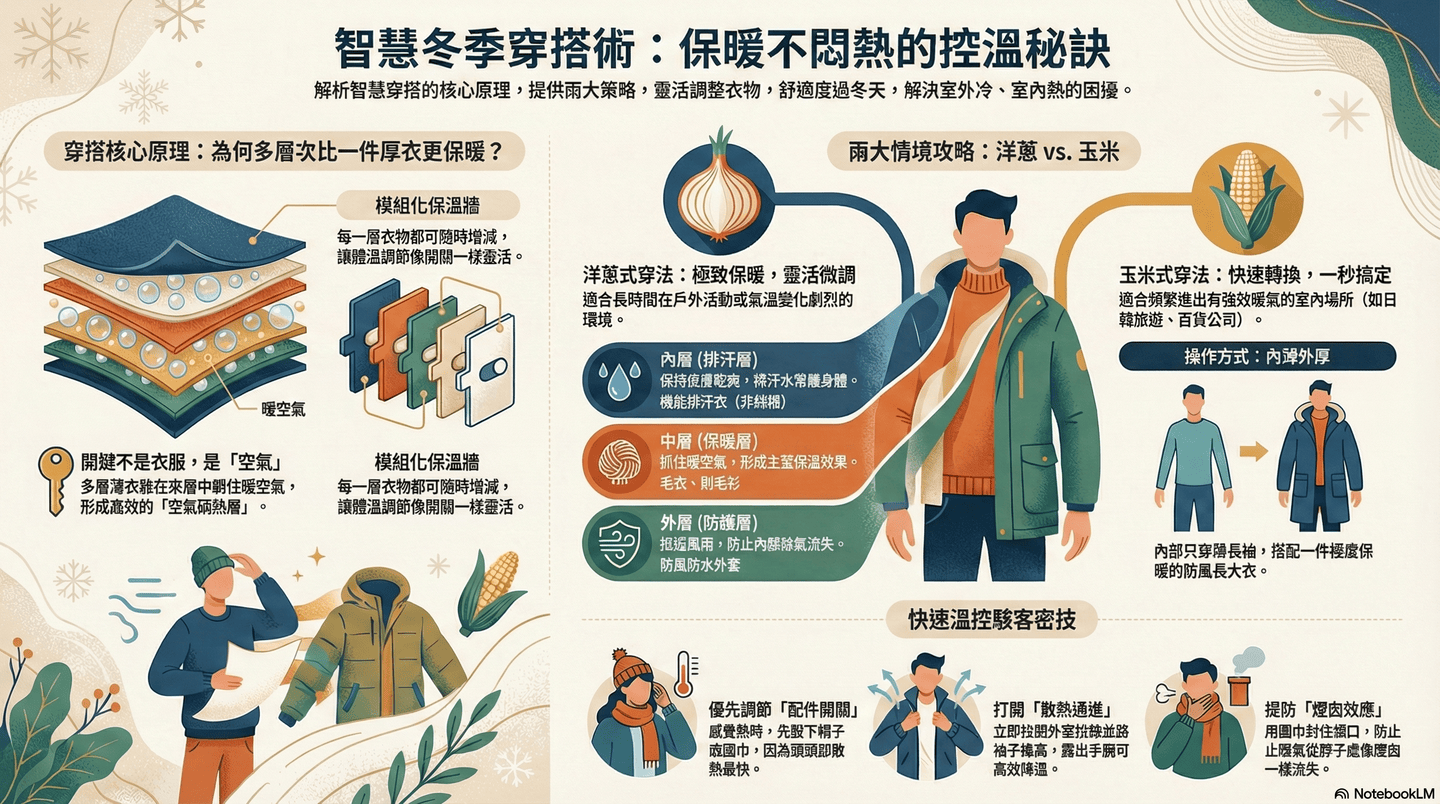
Why is “Onion Layering” So Magical?
Imagine your body is like a small space heater that’s constantly producing heat. If you only wear one super thick coat, it’s like putting a heavy “iron lid” on the heater. The heat can’t escape, but once you start moving or enter a heated room, that heat turns into a slow burn, causing your “core temperature” to overheat.
The science of “Onion Layering” isn’t about the clothes themselves, but the “air”!
You can think of the space between each layer of clothing as an “air insulation layer.” Just like a double-walled glass, there’s a layer of air in between. Multiple thin layers of clothing trap more air, forming several “insulation walls.” The best part is that this wall is “modular”—take a layer off when it’s hot, and put it back on when it’s cold.
The Classic Three-Layer Defense Strategy
| Layer | Purpose | Function | Example Clothing |
|---|---|---|---|
| Base Layer | Wicking | Responsible for quickly carrying sweat away. | Like a “water pump.” It whisks sweat away from your skin. Never wear pure cotton, as it stays wet like a damp cloth and will make you colder. |
| Mid Layer | Insulation | Responsible for trapping warm air. | Like a “dreamcatcher” for heat. It traps warm air—think sweaters or fleece. |
| Outer Layer | Shell | Needs to be windproof and waterproof to prevent cold air from blowing away the warmth inside. | Like “plastic wrap.” It blocks wind and rain so that external cold air doesn’t take away the warm air inside. |
Why Do People “Overheat” in Winter?
This is the classic “heated room tragedy.” It’s 10 degrees outside, you enter a department store dressed like a ball, and within five minutes, your forehead is sweating, your heart is racing, and you might even feel dizzy or nauseous. This is “Winter Heatstroke” (indoor overheating).
Actually, you’re experiencing a “thermos bottle spiritual event”: you put on a perfect lid (coat) but forgot to leave a ventilation hole.
How to Turn on Your “Temperature Control Switch”?
| Operation | Benefit |
|---|---|
| 1. Use the “Accessory Switch” Method | Don’t rely solely on your sweater for warmth. Use scarves, hats, and gloves. If you’re hot, don’t take off your coat first—remove your scarf or hat instead. The head and neck dissipate heat the fastest, helping you cool down by 2-3 degrees instantly. |
| 2. The Zipper Ladder Strategy | Don’t wait until you’re drenched in sweat to take something off. As soon as you step indoors, pull your zipper down halfway and expose your wrists (push up your sleeves). Wrists have many blood vessels and are highly efficient at dissipating heat. |
| 3. Watch Your “Philtrum” (The area above your upper lip) | This is an advanced hacker tip. If your philtrum starts sweating, it means your brain is issuing a “cooling command.” At this point, unzip immediately—don’t wait until your back is soaked, otherwise, you’ll catch a cold when the breeze hits you! |
What to Do if Thermal Wear Causes Skin Allergies or Itchiness?
This is the legendary “betrayal of thermal wear.” You step indoors, and your back feels like thousands of ants are having a party? It’s not because your skin is too delicate; it’s because you’ve turned your thermal wear into a “portable steamer.”
Hacker Moves to Tame Thermal Wear
| Operation | Benefit |
|---|---|
| 1. Physical Insulation Method | Wear a thin pure cotton or silk camisole/undershirt under your thermal wear. This “buffer layer” absorbs sweat, allowing the thermal wear to absorb the moisture from the undershirt to generate heat, while protecting your skin from being dried out. |
| 2. Lotion Barrier | Apply lotion containing “ceramides” or “Vaseline” before dressing. This creates a transparent protective film that prevents the thermal wear from excessively stripping your skin of moisture and oils. |
| 3. Material Selection | Avoid 100% synthetic materials. Look for thermal wear blends that contain “silk protein” or “Tencel.” |
The Ultimate Clothing Strategy Comparison
Depending on the situation, you can choose the best “clothing tactic”:
| Strategy Name | Operation | Benefits | Best Use Case |
|---|---|---|---|
| Onion Layering | Base (wicking) + Mid (insulation) + Outer (windproof) | Maximum warmth with flexible adjustments. | Hiking, running, or drastic temperature changes. |
| Corn Layering | Thin inner layer + extremely warm windproof coat | Fast transition; takes only a second to adjust indoors. | Regions with strong heating (like Japan or Korea). |
| Accessory Control | Use scarves, hats, and gloves for regulation. | Fastest response without needing to undress completely. | Frequently entering and exiting subways or malls. |
| Material Swap | Use natural fibers like Merino wool. | Warm yet breathable; wicks moisture without smelling. | All-day outdoor activities or long-distance travel. |
Summary: Hacker-Level Winter Warmth Logic
| Operation | Benefit |
|---|---|
| Beginner Version | Remember the mantra: “Thin inside, warm in the middle, windproof outside.” As long as the outermost layer blocks the wind, 80% of the warmth is secured. |
| Advanced Version | Follow the “Minus 5 Degree Rule.” If you’ll be walking, dress as if it’s “5 degrees warmer” than the current temperature. The heat generated from walking will perfectly bridge the gap. |
| Beware the Chimney Effect | Feel a chill down your back? Your collar might not be sealed properly. Wrap a scarf to seal the collar so heat doesn’t escape like smoke up a chimney. |
Have you ever felt cold even after wearing a lot of clothes? Hurry up and check your collar—don’t let your warmth be sucked away by that “chimney”!