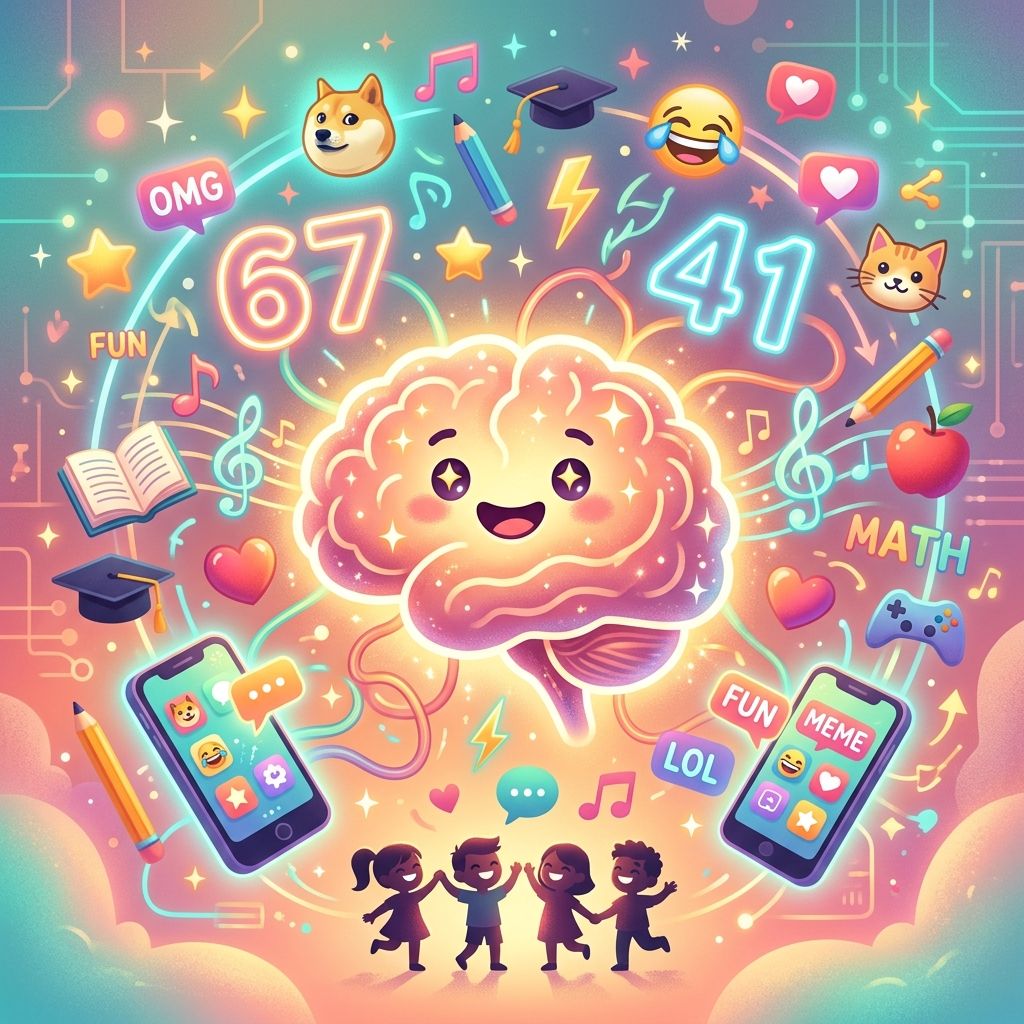
Whether watching international news or scrolling through social media short videos, teenagers in both Western and Chinese-speaking regions seem to be shouting a mysterious number: 67. As soon as someone starts, everyone nearby immediately joins in the excitement.
What is even more magical is that this nonsensical number was not only chosen as the 2025 Word of the Year by the well-known online dictionary Dictionary.com, but even Google Search designed a mysterious easter egg for it. Just type this number into the search box, and the entire web page will shake violently like an earthquake!
This is the magical slang that dominates Generation Alpha.
But how did this meaningless number go viral, and how has it become a schoolyard-sweeping linguistic revolution?
A Random Internet Collision: The Magical Viral Road of the Number “67”
The birth of this meme was initially a random collision on the internet.
It originally originated from the song "
Doot Doot (6 7)" released by Philadelphia rapperSkrillaat the end of2023.
The 67 in the lyrics was originally just for rhyme, paying tribute to “67th Street in Philadelphia” where he grew up.
Rapper Skrilla later admitted in an exclusive interview:
He himself never gave this set of numbers any practical meaning, but precisely because it has no meaning, everyone started saying it instead.
However, this song was not the only key to the viral success. People noticed that NBA Charlotte Hornets star LaMelo Ball, whose height happens to be 6 feet 7 inches (about 200 cm), led many fans to start editing his highlights using this music, and “67” subsequently became his unofficial nickname.
What really made it uncontrollable was a courtside video in March 2024.
In the video, a young boy suddenly roared “Six-Seven!” to the camera while doing a catchy hand gesture.
This gesture was started by 13-year-old Maverick Trevillian, requiring the hands to swing left, right, up, and down in sync.
This sudden sense of absurdity and catchy rhythm instantly went viral on social media platforms like TikTok, officially lifting this number out of geographical and height boundaries, and elevating it into an all-encompassing magical symbol.
Those who get it just need to make eye contact and make this gesture to confirm they are “one of us”.
This nonsensical craze has penetrated into every corner of daily life:
- If you get order number
67at a burger joint, the entire venue will cheer instantly. - When students find any road signs or house numbers on the street containing
6and7, they quickly take photos and upload them to social media. - Even
Googleofficially joined the party; now, as long as you search “67” onGoogle, the browser page will shake violently.
High-Speed Algorithm Reshaping: “Semantic Bleaching” in Sociolinguistics
From the perspective of sociolinguistics, the viral popularity of the number “67” perfectly demonstrates the process of Semantic Bleaching.
“Semantic Bleaching” refers to the process in which a word, through dissemination and overuse, loses its original specific meaning, leaving only the function of expressing exclamation or emotion.
Driven by the high-speed propagation of the TikTok algorithm, these original geographical and height associations were thoroughly washed away in a few days.
When it spread to primary and secondary school classrooms worldwide, students didn’t need to know who Skrilla was at all.
The original context was discarded, and words no longer needed a “meaning” to thrive.
The propagation speed of the algorithm has far surpassed the speed of human cultural traceability.
Astoundingly, this meaningless number beat out many famous words to be selected as Dictionary.com’s 2025 Word of the Year!
A number that has absolutely no substantive grammatical meaning has become the cultural symbol that best represents the year, which is precisely a profound linguistic and social change under the algorithmic era.
“Brainrot” Meme Culture and the “Social Passport” to Draw Boundaries
This schoolyard-dominating number “67” is classified as a Brainrot Meme in subculture.
“Brainrot” is characterized by the pursuit of meaningless humor and low-quality entertainment pleasures.
It is fundamentally different from number memes of past generations that had specific implications (such as 1069 representing sexual hints or 420 representing cannabis culture).
The core charm of “67” lies precisely in its “emptiness”.
It serves as a powerful Shibboleth social code function:
| Code | Explanation |
|---|---|
| Social Passport | Shouting 67 or making the mysterious gesture can quickly identify oneself as part of this specific group. |
| Building Belonging | Reposting, commenting, and matching codes on social media can help children find security in their echo chambers. |
| Creating Echo Chambers | Through this barrier of “only we understand, adults don’t”, a generational boundary is drawn. |
This “meaningless” game has even evolved into dynamic classes and competition. Recently, the number 41, from another lyric, has risen rapidly.
Among teenagers, it has even sparked fierce debates: does 67 or 41 have more Aura?
This behavior of giving “aura” to abstract and random symbols reflects the organic vitality of human order-making.
They make their own rules and establish symbol hierarchies in a meaningless universe, which was completely unimaginable as dynamic social competition in the era without social media and algorithms.
Classroom Nightmare: The Magic Duel of Teacher-Student “Fighting Poison with Old-School Poison”
In schools, this number has become the collective nightmare of countless educators.
A survey of 10,000 teachers in the UK showed that up to 80% of teachers had heard students shouting this word in the past week.
As long as the keyword appears in the classroom, the room will instantly lose control:
| Trigger Scenario | Student Reaction | Teacher State |
|---|---|---|
| The teacher says “please turn to page 67” | The whole class shouts “Six-Seven!” collectively and wildly makes gestures | Completely dumbfounded |
| History class mentions “in the year 1967” | The class explodes instantly, with left and right sides shouting back and forth | Smirking helplessly |
| The math answer turns out to be 67 | The whole class riots collectively like they took catnip | On the verge of collapse |
A Texas middle school teacher even expressed helplessly that in order to prevent sudden collective frenzy, he now has to deliberately avoid “groups of six or seven” when grouping students.
To survive, teachers have also developed the wisdom of “fighting magic with magic,” launching a strategic co-optation campaign:
| Coping Strategy | Specific Practice | Core Principle |
|---|---|---|
| Call-and-Response | The teacher shouts “six”, the students shout “seven” and then keep quiet | An order-guiding method similar to “shhh” |
| Old-School Destruction | The teacher deliberately acts old-fashioned and uses this meme excessively in class | Destroys the rebellion and mystery of the meme through adult intervention |
| Fighting Poison with Tests | Deliberately using AI to write a quiz where all answers are 67 | Making students feel tired and embarrassed of this number |
The biggest appeal of memes to teenagers is “the coolness of being incomprehensible to adults”.
Once the teacher also starts saying 67 with an “old-school cringey style”, the word instantly becomes very cringey and no longer cool in the students’ eyes, and they will automatically shut up because they feel embarrassed.
Embracing the Most Precious “Organic Human Connection” in the AI Era
The New York Times pointed out an extremely sharp observation in its report:
For Generation Alpha, who have lived on social media since birth and whose lives seem to be constantly scrutinized, “67” is like an invisible protective wall. In a world where any information can be easily searched on the internet, young people deliberately creating a
cringey inside-joke that cannot be translated and has no logic is actually a way for them to preserve their freedom.
The pursuit and deciphering by adults actually add more to the absurdity and fun of this silly joke.
Not needing to be understood is the greatest freedom itself.
This meaningless set of numbers is actually a subtle rebellion of refusal to be categorized and defined by the younger generation.
In a standardized era generated by artificial intelligence where words are extremely precise and logically perfect, this logical breakdown, even slightly foolish "brainrot" meme, is actually the most authentic manifestation of human vitality.
These rough, low-quality but rhythm-filled collective frenzies are precisely the organic connections unique to humans that have not been formatted by machines.
Compared to cold, correct algorithmic recommendations, this nonsensical joy of people shouting after making eye contact is what is most real.
“67” as the Word of the Year might be the most perfect metaphor for the era.
It reminds us that language is not just a tool for precisely conveying information, but also a manifestation of generational self-awareness and identity.
Outside the modern adult world that pursues efficiency and correctness, occasionally preserving a bit of meaningless blankness and absurdity might be the gentlest remedy for this era.
The next time you hear “Six-Seven”, you might as well open your heart, let go of your baggage, and laughingly appreciate this purest and most vibrant human connection!