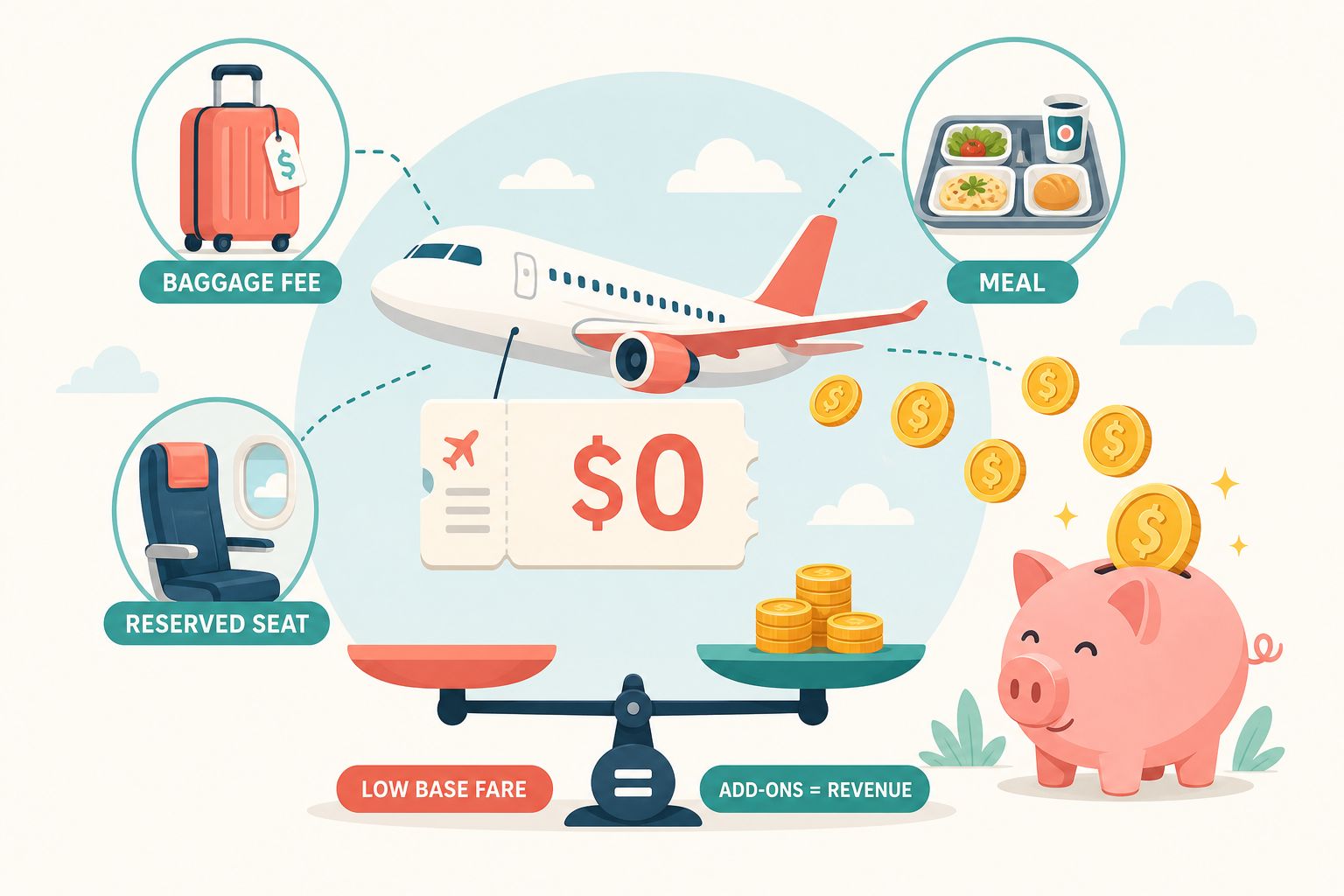
Every time a budget airline calls out “$0 tickets”, it always triggers a rush buying frenzy within a few minutes. Aren’t you curious:
Since tickets are free, how on earth do airlines make money?
What’s even more confusing is, do they really have to pay airport tax out of their own pockets for these empty seats?
Tickets are free, so how do airlines actually make money?
Let’s debunk the first myth: $0 tickets are never truly free.
“$0” is only the fare itself zeroed out; airport taxes and surcharges are still paid by you.
In other words, what the airline gives away is just the price of the “seat” itself, not all the costs of the entire trip.
The airport tax part is paid by you from start to finish; the airline is just collecting it on behalf of the government.
Do airlines pay airport taxes for unsold, empty seats?
The answer is no.
Airport tax is paid based on the actual number of boarding passengers. If a seat is empty and no one sits in it, there is no need to pay this tax.
Empty seats do not increase tax costs, which is one of the premises that makes $0 tickets possible.
Empty seats don’t require airport tax, so what are airlines losing?
Since empty seats don’t require paying taxes, and keeping seats empty doesn’t cost extra money in theory, why do airlines go through all the trouble to clear out seats in a way that is almost like “giving them away”?
The key lies in a cruel fact:
Once a plane decides to take off, the vast majority of costs have already occurred.
You can think of a plane ready to take off as a taxi that has already started and has its accelerator pressed to the floor. No matter whether there is 1 or 4 passengers in the back seat, the fuel money, driver’s salary, and vehicle depreciation are unavoidable.
The same is true for airlines. Aircraft leasing rent, pilots’ and flight attendants’ salaries, runway and maintenance fees—these fixed costs are already burned the moment the plane takes off.
Flying with empty seats is equivalent to wasting an opportunity to generate revenue for nothing.
The real body of budget airlines is things “outside the ticket”
Once you understand fixed costs, you can see the budget airlines’ entire game plan.
High fixed costs, extremely low marginal costs, and high-margin ancillary revenue are the real profit engines of budget airlines.
| Profit Logic | Explanation |
|---|---|
| Fixed Cost vs Marginal Cost | Fixed costs are huge, but the marginal cost of carrying one more passenger is extremely low, almost only adding a meal and a little fuel consumption. |
| Ancillary Revenue is the Real Body | Baggage fees, seat selection fees, meal fees, priority boarding fees—these combined can even account for 30 to 40% of total revenue. |
| Free Advertising and Marketing | $0 tickets bring their own buzz and traffic, saving huge advertising costs while cultivating a group of loyal customers. |
Connecting these three things reveals that airlines do not make money from selling tickets at all.
They first fill the seats with $0 tickets, and then earn back profits one by one from your baggage, seat selection, and meals.
The ticket is just an admission ticket to "invite you on the plane," and what really makes money is every optional add-on after boarding.
For budget airlines, a passenger who is willing to buy a $0 ticket and add 20 kg of baggage and a window seat might be more valuable than a passenger who only buys a discount ticket and doesn’t add any optional extras.
Then why do traditional airlines rarely play $0 tickets?
Seeing this, you might ask: since $0 tickets are so useful, why do traditional airlines like China Airlines and EVA Air rarely play them?
The difference lies in the business model.
Traditional airlines take a “bundled” service approach, where the ticket price already includes services like checked baggage, meals, and seat selection. They cannot split these items to sell them one by one, so they naturally have no room to make up for costs with ancillary revenues.
Budget airlines sell services split apart, while traditional airlines sell services bundled together, which determines who can afford to play $0 tickets.
In other words, $0 tickets are not airlines being charitable, but a promotional method that only a "split-selling" business model can support.
For you, a $0 ticket is actually a trade of "time and flexibility" for "money."
If you are willing to pack light, not choose seats, and not eat plane meals, you can exchange that for an ultra-cheap ticket; while the airline monetizes idle seats and gets a wave of free exposure in the process.
Saying that, this is a commercial game where each gets what they need. Understanding this logic, next time you grab a $0 ticket, you will know exactly what you are buying and what you are paying.