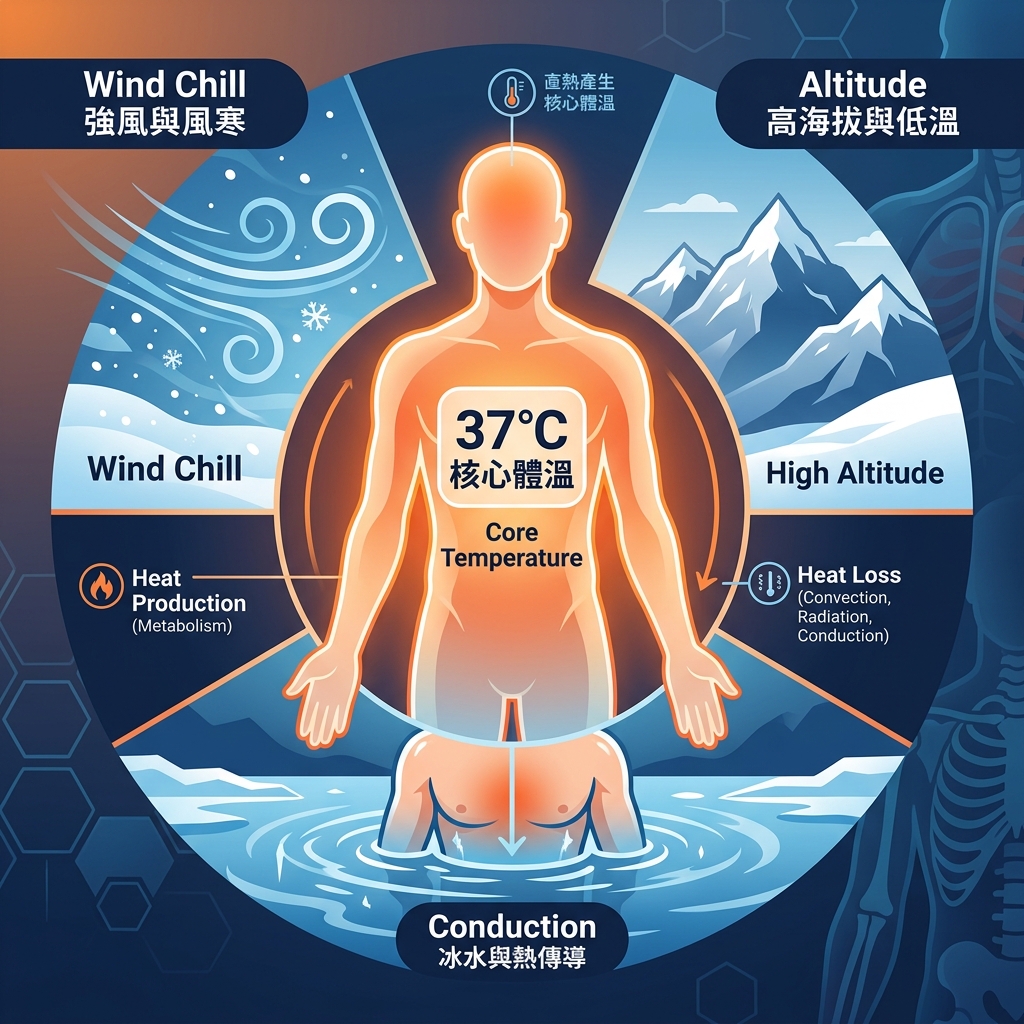
Imagine that our body is like a five-star hotel with 24/7 climate control.
No matter whether it’s scorching sun or wind and rain outside, the hotel’s central air conditioning (the brain’s thermoregulation center) works hard to keep the temperature around 37°C, so that all the guest rooms (our organs) can function normally.
But when the wind is too strong, the altitude is too high, or the environment is too wet, this “body temperature defense battle” becomes extraordinarily difficult.
Let’s explore from a physiological science perspective how these “temperature thieves” operate, and how to properly rescue yourself and others when defenses collapse.
Who’s Stealing Your Heat? The Three Major Environmental Variables
To keep the hotel’s heating intact, we first need to identify three uninvited “temperature robbers”:
| Condition | Summary | Explanation |
|---|---|---|
| Wind Chill Effect | The “invisible giant fan” that blows away warmth | Our skin surface actually has a thin layer of warm air, like an “invisible coat.” Once wind speed increases, this warm air gets blown away rapidly — this is convective heat loss in physics. That’s why at an air temperature of 10°C, if wind speed reaches 30 km/h, your perceived temperature instantly drops to around 0°C. The faster the wind, the exponentially faster heat is lost. |
| Altitude | The “freezer effect” of thin air | As altitude increases, air pressure decreases, and temperature naturally drops. In meteorology, for every 100 meters of elevation gain, temperature drops by approximately 0.6°C. If you climb from sea level to a 3,000-meter mountain, the temperature drops by a full 18°C. Combined with strong mountain winds and thin oxygen (reduced body heat production efficiency), the cold feels much more intense than at lower elevations. |
| Water Chill Effect | The “vacuum cleaner” of heat | If air is a thief that slowly steals heat, water is a powerful vacuum cleaner of heat. Water conducts heat approximately 25 times faster than air! This means that in 20°C water, your rate of heat loss is comparable to standing naked in 0°C air. |
When Core Temperature Falls: The Three Stages of Hypothermia
When environmental stress overwhelms the body’s regulatory capacity, and core body temperature drops below 35°C, you enter what’s known as “hypothermia”.
We can divide hypothermia into three stages:
| Stage | Core Temperature | Body Response (The Guard Team’s Actions) | Risk Level |
|---|---|---|---|
| Mild Hypothermia | 35°C - 32°C | Intense shivering, increased heart rate. The muscles are jogging in place to generate heat. | Caution |
| Moderate Hypothermia | 32°C - 28°C | Shivering stops (energy depleted), confusion, heart rate slows. | Dangerous |
| Severe Hypothermia | < 28°C | Coma, undetectable blood pressure — appears as if dead. | Fatal |
Special reminder: Diabetic patients, those with low blood sugar, or elderly people living alone are more vulnerable to hypothermia crises due to weaker thermoregulation capabilities.
Hypothermia First Aid: 3 Things You Must Get Right
If you notice someone around you becoming confused, slurring their speech, and having cold skin (placing your palm on their upper abdomen is the most accurate check), be sure to follow these correct care procedures:
1. Cut Off the Heat Loss Source
The first step is always “stop the loss.”
| Method | Explanation |
|---|---|
| Remove wet clothing | Water chill effect is lethal — you must immediately change into dry clothing. |
| Move to a sheltered area | Avoid cold wind from continuing to blow (wind chill effect). |
2. Rewarm Correctly (Not Too Fast!)
The recommended rewarming rate is 0.5–1°C per hour.
| Method | Explanation |
|---|---|
| Torso first | Wrap heat packs or hot water bottles in towels and place on the neck, armpits, and groin (inner thighs). |
| Do not immerse in hot water directly | Rapid temperature changes may cause shock. |
3. When to Give Hot Drinks
This is extremely important! Only after the patient is “conscious” and has “stopped shivering” can you give warm, high-calorie drinks (such as hot chocolate).
Critical First Aid Mistakes: Never Make These Errors
In moments of panic, many people make wrong moves that actually harm the patient:
| Incorrect Action | Explanation |
|---|---|
| Do not drink coffee or alcohol | Alcohol causes blood vessels to dilate, actually causing faster heat loss and lower blood pressure. |
| Do not vigorously rub the patient’s body | Massaging limbs causes cold blood to rush back to the heart, potentially causing cardiac arrest. |
| Do not move the patient roughly | A hypothermic person’s heart is extremely fragile — excessive movement may trigger cardiac arrhythmia. |
In Summary
Protecting the 37°C core body temperature requires not just thick clothing, but correct knowledge.
Understand the power of wind speed and water temperature, and master the principles of “slow rewarming” and “protecting the torso.”
The right first aid actions can often save a life in those critical few minutes.
Next time you head out for outdoor activities, remember to equip your body — this “five-star hotel” — with windproof and waterproof outer walls, and don’t let environmental thieves steal your warmth!