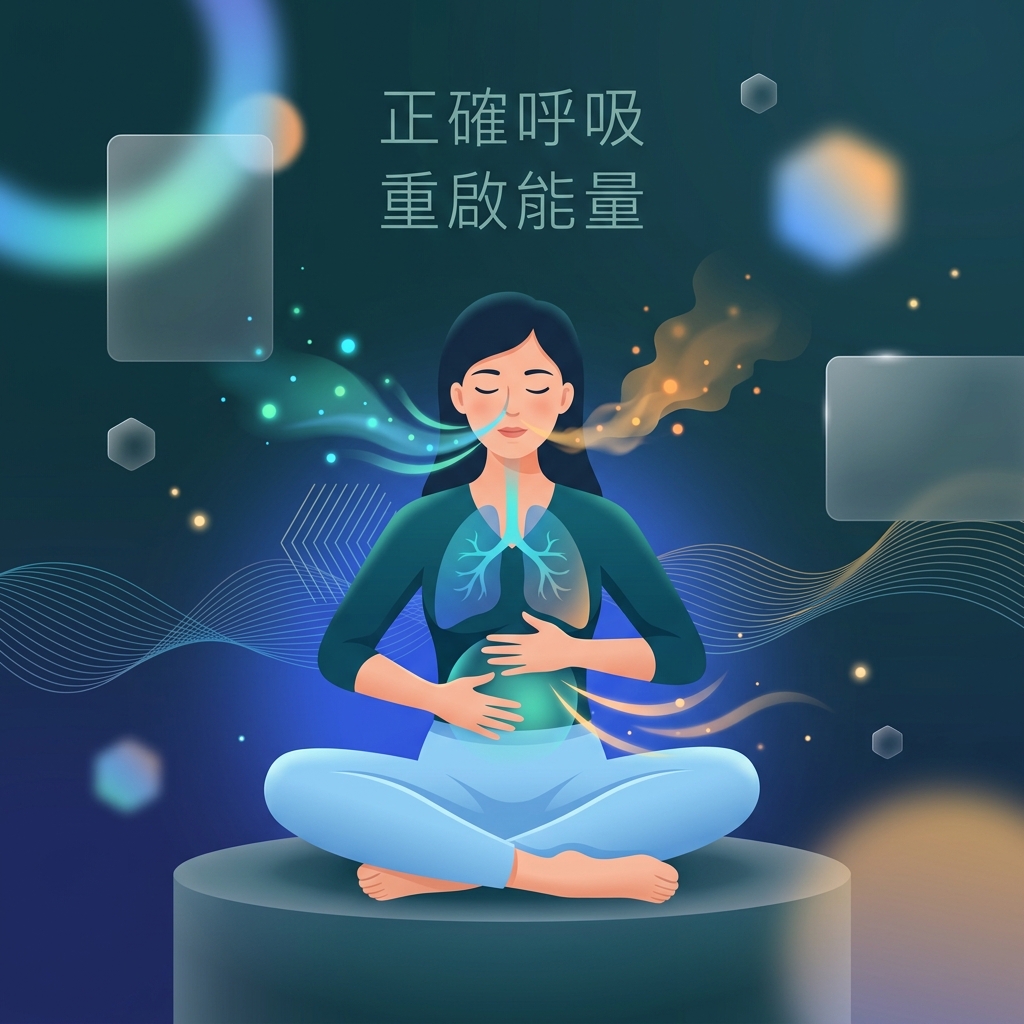
Have you ever felt this way? You’re just sitting at your desk, not moving at all, yet your chest feels tight, as if every breath you take isn’t quite enough, and you can’t help but let out a big sigh.
It’s not that your lungs have a problem — it’s that your body is sending a signal that your respiratory system needs a reset.
Modern people are constantly living in high-stress, sedentary environments, and the brain quietly switches into “survival mode,” making our breathing become short and shallow.
Why is it so hard to “breathe properly”? Let’s explore how neuroscience can help us find our body’s natural rhythm.
The “Energy-Draining Mode” of Modern Breathing: Why Do We Get More Tired the More We Breathe?
Many people think breathing is a natural instinct that doesn’t need to be learned.
The truth is, our breathing patterns often “go off track” due to stress.
There are two common types of incorrect breathing:
1. The Energy-Draining “Chest Breathing”
When you feel anxious, your shoulders unconsciously rise — this is classic chest breathing.
This method mainly relies on neck and shoulder muscles (accessory respiratory muscles) to drive breathing. Over time, not only is oxygen exchange efficiency low, but it also leads to severe neck and shoulder stiffness and chronic fatigue.
2. The “Mouth Breathing” That Loses the Key
Are you used to breathing through your mouth?
This could trap you in a state of “virtual oxygen deprivation.”
Here we need to introduce a scientific principle: the Bohr Effect.
Simply put, carbon dioxide is not just a waste product — it’s the “key” that makes red blood cells release oxygen.
When we breathe rapidly through our mouth in large gulps, we excessively expel carbon dioxide from our body.
Without this key, even if the oxygen level in your blood is high, red blood cells will stubbornly hold onto oxygen, leaving your brain and organs starved for energy.
This is why, even though you feel like you’ve been breathing plenty, you still feel dizzy, have cold hands and feet, and experience skyrocketing anxiety.
Breathing Is Your Nervous System’s “Manual Override”
The most remarkable thing about breathing is that it’s the only function in the autonomic nervous system that we can “manually intervene” in.
Think of the autonomic nervous system as a car’s gas pedal and brake:
| Breathing | Description |
|---|---|
| Inhaling | Slightly suppresses the parasympathetic nervous system, like gently pressing the gas pedal. |
| Exhaling | Stimulates the vagus nerve, directly activating the parasympathetic nervous system — essentially hitting the brake. |
So, to calm down quickly, the key isn’t about “how deeply you inhale,” but rather “how long you exhale.”
| Mode | Dominant System | Breathing Pattern | Key “Chemical Switch” |
|---|---|---|---|
| Fight Mode | Sympathetic Nervous System | Short, rapid, shallow; expelling large amounts of $CO_2$ | CO₂ too low (blood becomes alkaline) |
| Recovery Mode | Vagus Nerve | Deep, long, slow; retaining adequate $CO_2$ | CO₂ stable (stimulates vagus nerve) |
Daily Breathing Reset Exercise: Start with “Energy Saving”
To switch from “energy-draining mode” back to “energy-saving mode,” you can start with these three simple steps:
| Step | Description |
|---|---|
| 1. Switch to Nasal Breathing | Your nose is a natural “air conditioner” that warms and humidifies air, and through its smaller openings limits airflow, preventing carbon dioxide from escaping too quickly and maintaining your body’s “chemical balance.” |
| 2. Activate the Diaphragm Pump (Diaphragmatic Breathing) | Try placing your hand above your navel — feel your belly gently rise as you inhale, rather than your shoulders pulling up. Diaphragmatic breathing allows you to inhale the most oxygen with the least energy expenditure — it’s your body’s most efficient way to fuel itself. |
| 3. Practice the “1:2 Exhale Method” | This is the fastest technique to activate the vagus nerve: * Inhale through your nose for 2 seconds. * Imagine blowing on hot soup, slowly exhale through your mouth (or nose) for 4 seconds. |
With just 60 seconds of consistent practice, your heartbeat will noticeably stabilize, and your brain will receive the signal that “you are safe now.”
Key Takeaways
Breathing is the action you perform most throughout the day, and it’s the fastest path to controlling your emotions. When you feel anxious or fatigued:
Close your mouth, switch to nasal breathing, and take a deep, long exhale.
Keep the “carbon dioxide key” in place, and let oxygen truly reach your cells.
Starting today, practice switching your breathing from “autopilot” back to “manual reset”!