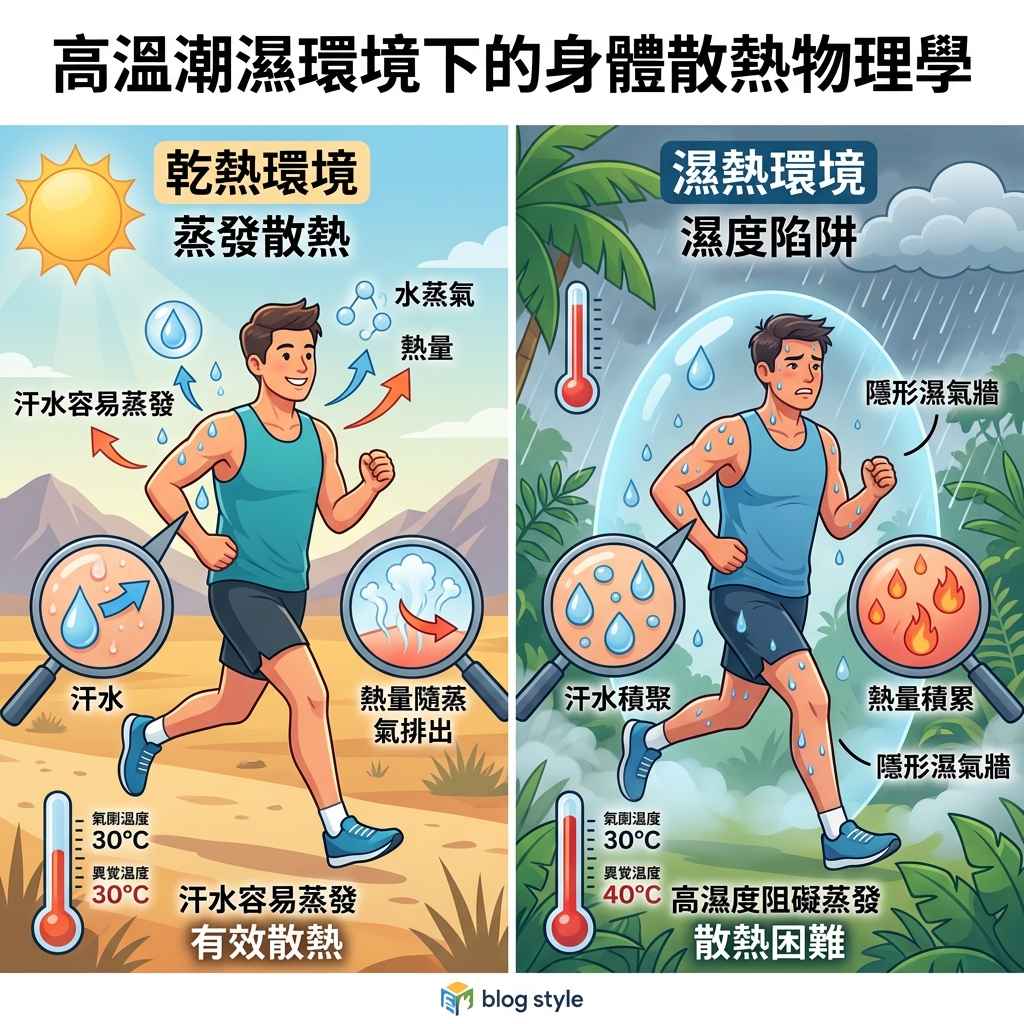
Have you ever had this experience: the thermometer reads only 30°C, yet when you step outside, you feel like you’re being “steamed alive”? That sticky, sweaty feeling where no amount of breeze brings relief can really make you question everything.
It’s not your imagination — it’s the humidity in the air messing with your body’s heat dissipation system!
The Invisible Wall of Humidity: Why Does Sweating Profusely Do Nothing?
To understand why humid heat feels so much worse than dry heat, we first need to talk about the body’s most powerful cooling mechanism: evaporative cooling.
Imagine your body as a high-performance computer running at full speed, and sweating is your “liquid cooling system.” When sweat transitions from liquid to gas as it leaves your skin, it carries away a massive amount of energy — this is known in physics as the heat of vaporization.
| Environment | Description |
|---|---|
| Dry heat | The air acts like a dry sponge, easily absorbing your sweat. Sweat evaporates quickly, carrying away more body heat, so you naturally feel cooler. |
| Humid heat (like Taiwan) | The air is already like a fully saturated wet sponge. When you try to sweat, the air says: “Sorry, we’re full!” Sweat flows out but can’t enter the air — it just sits on your skin surface. |
This is what’s known as the “humidity trap.”
Body heat gets locked inside by this “invisible wall,” causing your core body temperature to keep rising.
This is also why weather agencies calculate that alarming apparent temperature — because it factors in the cost of “being unable to dissipate heat.”
The Limits of Wind Speed: When Your Fan Turns Into a “Hair Dryer”
When it comes to cooling down, many people’s first instinct is to “turn on the electric fan.”
Wind can indeed blow away the moisture barrier on your skin’s surface, helping sweat evaporate. But did you know? Wind speed has a limit to its cooling effect.
This involves the mechanism of Convection in physics. Under normal conditions, wind is the “delivery truck” that carries body heat away.
But when the air temperature soars above your body temperature (around 35-37°C), the situation completely reverses:
| Scenario | Description |
|---|---|
| The tipping point | When ambient temperature > body temperature, the fan no longer blows cool air — instead, it becomes a “heat delivery worker” loaded with thermal energy. |
| The reversal | At this point, the fan essentially becomes an industrial-grade hair dryer, forcibly “unloading” external heat onto your skin. |
If you’re already dehydrated and unable to sweat, blasting yourself with a big fan at this point will actually make your body heat up faster, increasing the risk of heatstroke!
Breaking the Physical Ceiling: Precision Cooling Strategies
Now that we understand the physical limitations that temperature and humidity impose on the body, how can we cool down scientifically?
| Cooling Method | Physical Principle | Best Suited For |
|---|---|---|
| Turn on dehumidifier mode | “Wring out” the air sponge, restoring sweat’s ability to evaporate | When feeling muggy indoors with sticky skin |
| Sun shading | Block radiant heat, reducing direct solar heating of the skin | Outdoor sun-exposed paths, walking under intense sunlight |
| Artificial mist/water spray | Provide additional cooling resources, forcibly carrying away heat | Outdoors when temperatures are extreme but air is dry |
| Ice packs on major arteries | Directly absorb blood heat through contact, without relying on evaporation | Extremely high body temperature, suspected heatstroke emergency |
The Myth of Moisture-Wicking Clothing
Many people think wearing moisture-wicking clothing solves everything, but if the humidity is too high and there’s no air circulation, once the moisture-wicking shirt is soaked through, it actually becomes like wrapping yourself in a wet rag, hindering heat dissipation.
Conclusion: Be Your Own Heat Dissipation Master
By understanding the physical variables in our environment (temperature, humidity, wind speed, radiant heat), we can protect ourselves more intelligently.
Next time you feel unbearably muggy, first check whether the “air sponge” is too saturated?
By timely changing your environment, staying hydrated, and replenishing electrolytes (the toll fee for keeping your cooling pump running), you can precisely build your own cooling shield to beat any scorching summer.