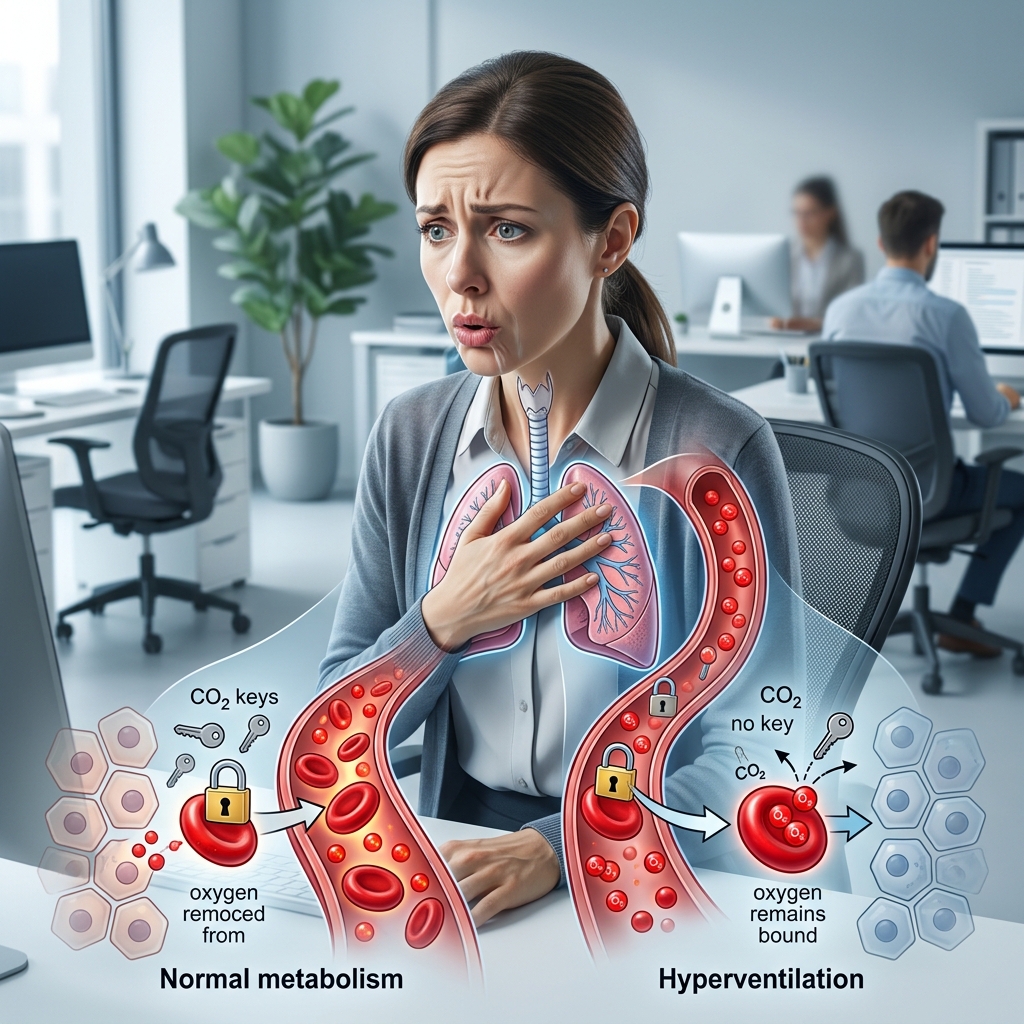
Have you ever experienced a moment of extreme nervousness, a heated argument, or overwhelming pressure, only to suddenly feel like your lungs are blocked and you “can’t get enough air”? Then your heart starts racing, your fingertips and lips begin to tingle and go numb, and you feel like you’re about to suffocate?
This terrifying sensation often makes people think they’re having a heart attack or stroke, but if you go to the ER for a checkup, the doctor might give you a diagnosis that sounds less alarming:
Hyperventilation Syndrome.
This is actually your body sending out a “false alarm.” You’re not truly oxygen-deprived — instead, because you’re breathing too fast, your body has lost the most important “key”: carbon dioxide.
Why Does “Breathing Harder” Actually Make You Feel More Suffocated?
Under normal physiological mechanisms, breathing works like a sophisticated “delivery service.” Oxygen is the cargo, and red blood cells are the delivery trucks.
But for these trucks to “unload” oxygen to your cells, they need the “key” of carbon dioxide (CO₂) to unlock the delivery.
When you begin breathing rapidly and deeply due to acute anxiety or panic, although you’re inhaling plenty of oxygen, you’re also excessively expelling carbon dioxide. This triggers the following chain reaction:
| Body Mechanism | Explanation |
|---|---|
| 1. Respiratory Alkalosis | Carbon dioxide levels in the blood plummet, causing the pH to rise (becoming alkaline). |
| 2. Phantom Hypoxia (Bohr Effect) | According to the “Bohr Effect,” when blood becomes alkaline and lacks the CO₂ key, red blood cells cling tightly to oxygen and refuse to release it. |
| 3. False Alarm Triggered | Although your blood oxygen saturation might be 100%, cells in your brain and extremities can’t access the oxygen and start sending “hypoxia” signals, triggering chest tightness, palpitations, and tingling in hands and feet. |
This is the most paradoxical part: You feel like you’re suffocating because you’re “breathing too much,” not “breathing too little.”
Recognizing Common Signs of Hyperventilation
Hyperventilation syndrome is usually closely linked to emotional stress. Common symptoms include:
| Symptom | Explanation |
|---|---|
| Difficulty Breathing | A subjective feeling of insufficient air, unconsciously wanting to take deep breaths. |
| Limb Numbness | Tingling in fingertips, toes, or around the lips — a pins-and-needles, electric-shock-like numbness. |
| Psychological Panic | Extreme unease, fear, and even a sense of impending death. |
| Physical Reactions | Rapid heartbeat, cold sweats, dizziness, and in severe cases, hand and foot spasms. |
When you notice these symptoms appearing, tell yourself:
“This is just an overreaction of my nervous system. I am safe right now. I am not oxygen-deprived.”
Practical First Aid: How to Recover the “CO₂ Key”?
When hyperventilation strikes, the most important goal is to “slow down breathing” and “retain carbon dioxide”. Here are scientifically effective steps:
| Step | Explanation |
|---|---|
| Reassurance & Cognitive Reframing | If you’re helping someone else, use a steady, calm tone to reassure the patient that this is a benign physiological response that can be relieved simply by adjusting breathing. |
| Pursed-Lip Breathing | Imagine you’re cooling a bowl of hot soup. Inhale for 2 seconds, then purse your lips (as if whistling) and exhale slowly for 4 to 6 seconds. This artificially increases breathing resistance, preventing carbon dioxide from escaping too quickly. |
| Hand-Cupping Method | If you don’t have any equipment nearby, cup both hands together over your nose and mouth as if scooping water. This allows you to rebreathe some of the carbon dioxide you just exhaled, helping blood pH quickly return to balance and releasing the red blood cells’ lock on oxygen. |
In the past, placing a paper bag over the nose and mouth was a common practice, but modern medicine advises against self-administering this method.
Because if the patient is not “hyperventilating” but actually experiencing genuine “low blood oxygen” (such as a heart attack or asthma), using a paper bag could create a real oxygen deprivation danger.
Therefore, “reassurance” and “controlled breathing” are the safest approaches.
Long-Term Prevention: Don’t Let Your Body Stay in “Fight Mode”
Hyperventilation is often an eruption after long-term stress accumulation. To prevent recurrent episodes, start with these lifestyle adjustments:
| Method | Explanation |
|---|---|
| Practice Diaphragmatic Breathing | Practice 5-10 minutes daily, handing breathing control to the diaphragm and avoiding reliance on shallow shoulder and neck muscle breathing. |
| Regular Exercise | Exercise can improve the body’s tolerance for carbon dioxide and help stabilize the autonomic nervous system. |
| Reduce Stimulants | Caffeine and alcohol can trigger palpitations and anxiety, making hyperventilation more likely. |
| Stress Management | Find suitable stress-relief outlets, such as meditation, counseling, or hobbies, giving your nervous system a chance to “clock out.” |
Conclusion: Take Back Control of Your Body
Hyperventilation syndrome may feel terrifying, but at its core, it’s your body’s “extreme protest” against stress.
Once you understand the principle of the “CO₂ key,” you no longer need to fear that suffocating sensation.
Next time pressure hits and your breathing starts racing, try closing your mouth and slowing your pace. You’ll discover that as long as you find that key, comfortable breathing has been there all along.