Have you ever noticed that when summer comes and the sun is blazing, even though you haven’t done any exercise, you somehow can’t eat anything, and you even get random dizziness and leg cramps?
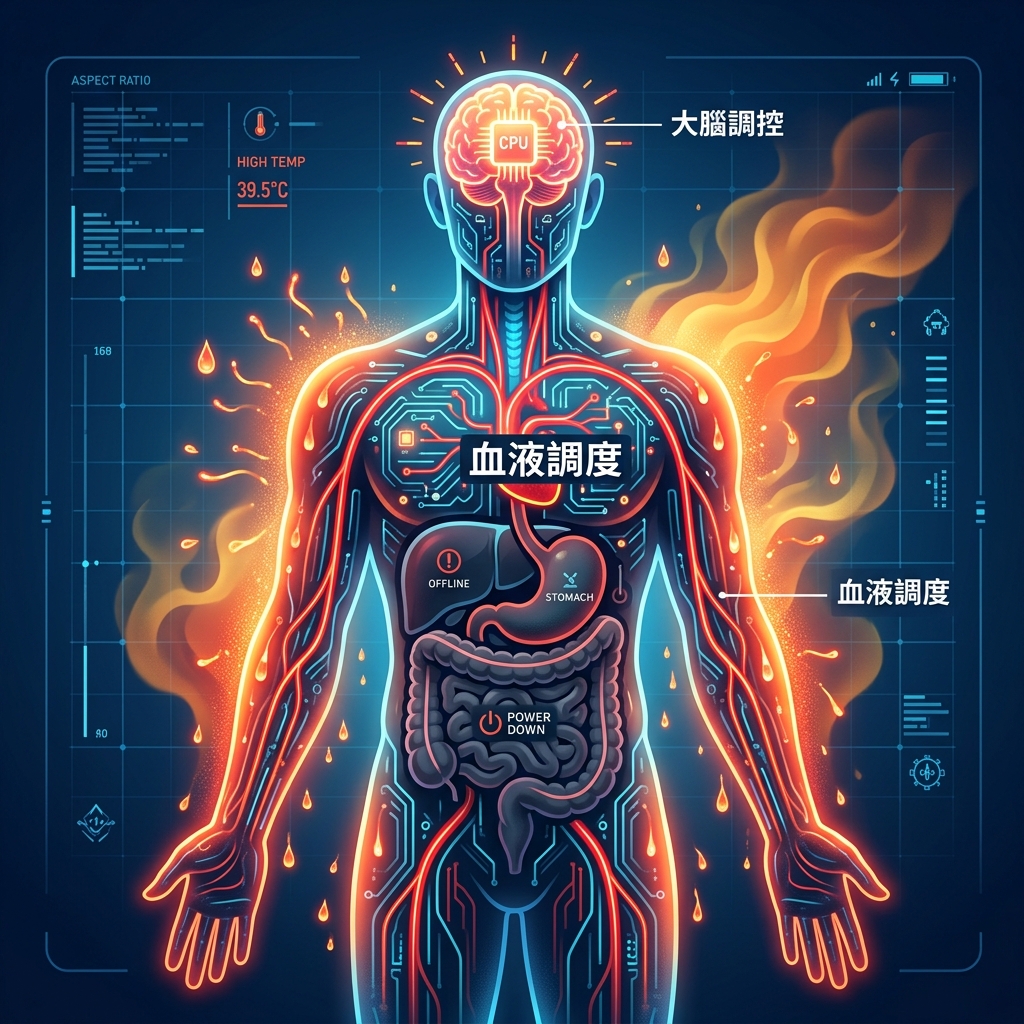
This isn’t because your stomach is sick — it’s because the “building manager” in your brain is trying to prevent your body from overheating and crashing, carrying out an emergency resource redistribution battle.
Your Body’s Building Manager: The Hypothalamus and Its Blood Flow Redistribution
Imagine that our body is like a sophisticated office building, and the hypothalamus in your brain is the building’s property manager.
When the outside temperature soars and the building starts heating up, the manager, to prevent the servers (core organs) from burning out, issues a very forceful command:
“Redirect all
coolant (blood)to theexterior walls (skin surface)for heat dissipation!”
Why Do You Lose Your Appetite?
When a large amount of blood is redirected to the skin surface for sweating and heat dissipation, the blood flow originally supplying internal organs is forced to decrease.
So your
digestive systementers a “shutdown state”.
Because there isn’t enough blood, gastrointestinal motility slows down, and your brain simultaneously sends the signal “I don’t have time to process food right now” — that’s why you completely lose your appetite when you see a big meal on a scorching day.
Electrolytes: The “Toll Fee” That Powers the Cooling Pump
Many people think you just need to “drink tons of water” to beat heatstroke, but this is actually a very dangerous misconception.
If you think of blood as coolant, then “electrolytes” (mainly sodium and potassium) are the key signal operators that power the cooling pump.
The Brain’s Power Outage Warning
When you sweat heavily, you don’t just lose water — you also lose precious electrolytes.
If you only replenish with plain water, the sodium concentration in your body becomes overly diluted, and your body starts sending warnings:
| Condition | Symptom | Explanation |
|---|---|---|
| Signal Jammed | Heat Cramps | When electrolytes are insufficient, nerve signals malfunction, causing your muscles to cramp for no apparent reason — this is what’s known as “heat cramps.” |
| Headquarters Disconnected | Hyponatremia | Severe electrolyte imbalance can cause abnormal brain function, making you confused and sluggish — this means your “central processor” is about to give out. |
Two Stages of System Overheating: Heat Exhaustion vs Heatstroke
If resource redistribution still can’t save the day, your body enters the following two stages:
| Stage | Computer Analogy | Physical Symptoms |
|---|---|---|
| Heat Exhaustion | Fans spinning wildly but coolant running dry | Skin is cold and clammy, heavy sweating, normal or slightly elevated temperature, conscious and alert. |
| Heatstroke | Fans jammed, motherboard starting to burn | Skin is hot and dry with no sweat, temperature spikes above 40.5°C, confused, potentially fatal. |
Heat exhaustion is your body’s last line of defense — at this point, you’re still sweating frantically trying to cool down.
Once you enter heatstroke, it means the regulatory system has completely collapsed — every second is damaging your brain and organs.
How to Properly Perform “System Maintenance”?
To prevent your high-performance body from crashing, you can take the following strategies:
| Strategy | Explanation |
|---|---|
| Don’t wait until you’re thirsty to drink water | Thirst is your body’s “delayed alarm” that you’re already dehydrated. In high-temperature environments, you should take small sips of water every 15-20 minutes. |
| Remember to pay the “toll fee” | If you’ve been sweating heavily, make sure to replenish with sports drinks or salt water containing electrolytes. Never chug several liters of plain water in a short period — that could lead to dangerous “water intoxication” (hyponatremia). |
Emergency Response: Cooling First
If you notice someone around you is already unconscious and their skin is burning hot:
| Action | Explanation |
|---|---|
| Call 119 immediately. | Every second counts for rescue |
| Physical cooling | Move them to a shaded area, remove excess clothing, wipe their body with a wet towel and fan them. |
| Do not force-feed water | If the person is confused, forcing water could cause fluid to enter the airway and lead to choking. |
Key Takeaways
Our body is an incredibly smart and sophisticated device. In summer, loss of appetite and dizziness are your brain working hard to protect you.
As long as you understand these “distress signals” and provide the right hydration and electrolyte support, you can keep this high-performance machine running smoothly even in the scorching summer heat without overheating and crashing!