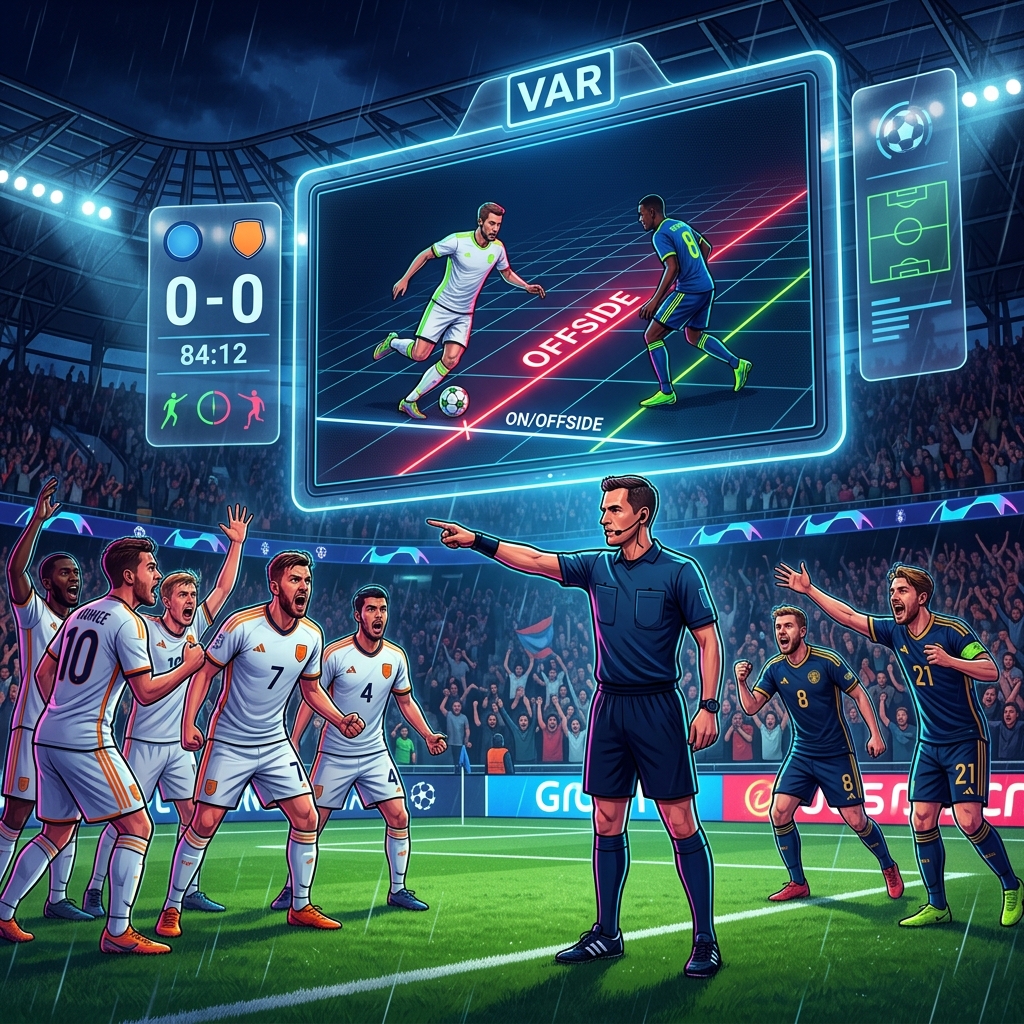
Watching football but can never understand what the referee is calling? Why does the entire stadium suddenly go silent after a goal, waiting for the referee to check the screen?
Many beginners watching the World Cup or league matches often feel like “these rules are way too mysterious.” In fact, football rules are designed to strike a balance between fluidity and fairness.
What Happens When the Ball Goes Out of Bounds? Three Ways to Restart Play
A football pitch is bordered by touchlines and goal lines (end lines).
The ball must “completely cross” the line to count as a goal or be out of bounds.
When the ball goes out of play, depending on who last touched it, there are three common ways to bring it back:
| Restart Method | Description |
|---|---|
| Goal Kick | The attacking team kicks the ball over the opponent’s goal line. The goalkeeper then kicks the ball out from the 6-yard box. |
| Corner Kick | The defending team kicks the ball over their own goal line. The attacking team can take a kick from the corner of the pitch and shoot directly at goal (yes, you really can score from it!). |
| Throw-in | The ball crosses the touchline on the side. The player must throw it back in using both hands, and you cannot score directly from a throw-in. |
What Exactly Counts as a Goal?
You might wonder: “Can the referee really see clearly whether the ball crossed the line?”
Remember the 2022 Qatar World Cup, when Japan’s “seemingly out-of-bounds” save against Spain? Technology showed the ball was just 1.88 cm on the line.
The reason is that football judgments are made in “three dimensions”
As long as the ball’s curved edge still overlaps with the vertical projection plane of the goal line, in 3D judgment logic, the ball is still “alive”! Even if the bottom of the ball is already past the line, it still counts as being in play.
In modern top-level competitions, “Goal-line Technology” helps out. In today’s elite matches, footballs even have sensors inside, transmitting data 500 times per second to the referee’s watch.
As soon as the ball completely crosses the line, the referee’s watch vibrates and displays “GOAL” — this technological enforcement has officially made “goal-line mysteries” a thing of the past, leaving absolutely no room for ambiguity.
Not Every Fall Is a Foul! The Referee’s “Three Standards”
Why is it that when players go down, sometimes the referee doesn’t react, but other times a red card is given?
Referees typically judge based on the severity of the action:
| Severity Level | Description |
|---|---|
| Careless | A minor action — only a free kick is awarded to the opposing team, no card given. |
| Reckless | Excessive force or disregard for opponent’s safety (e.g., sliding in knowing you can’t reach the ball) — the referee gives a yellow card. |
| Excessive Force | Endangering the opponent’s physical safety (e.g., studs up, violent conduct) — an immediate red card and ejection. |
If the defender “touches the ball first” before knocking the player down, referees usually consider it a fair physical challenge and won’t call a foul!
Fouls and Set-Piece Tactics: The “Fair Advantage” Within the Rules
Is fouling always a bad thing? From a tactical perspective, not necessarily.
Coaches teach players how to “calibrate the limits”, finding the sweet spot between careless, reckless, and excessive force.
Top defenders know how to “touch the ball first” and then take the player, or perform a “tactical foul” at critical moments to stop a counterattack.
Meanwhile, the attacking side uses the “quick free kick” rule, launching a surprise attack before the wall is set up — all of these are smart plays within the rules to secure victory.
The Psychological Warfare of Penalty Shootouts
When a match goes to a Penalty Shootout, it’s no longer just about skill — it becomes a psychological battle.
From the moment the “coin toss” happens, the mind games begin.
Statistics show that the team that shoots first wins about 60% of the time. Scoring first creates immense psychological pressure on the team shooting second.
Additionally, goalkeepers are now required to keep at least one foot on the goal line before the ball is kicked, which significantly boosts the kicker’s advantage and makes the psychological warfare of penalty shootouts even more intense.
The Most Mysterious Rule: What Exactly Is Offside?
Offside is the rule that confuses beginners the most in football. Its purpose is to prevent attacking players from constantly camping in front of the opponent’s goal, “cherry-picking”.
To determine offside, simply put, three conditions must be met:
- Being in the opponent’s half
- Closer to the goal line than the “ball”
- Closer to the goal line than the “second-to-last defender” (the goalkeeper is usually the last defender)
If a player receives the ball under these three conditions, the referee will raise the flag to signal offside.
However, if the player is still in their own half, or if the opponent “deliberately passes the ball” to them, it doesn’t count as offside!
Hair-Thin Offside: The Black Technology of Semi-Automated Offside System
The “Semi-Automated Offside System” that gives forwards the biggest headaches today.
In the past, drawing offside lines could take referees several minutes. Now, with 12 dedicated cameras above the pitch, the system can track 29 points on each player’s body.
As long as your toes, shoulders, or even a “strand of hair” are closer to the goal line than the second-to-last defender, the system can generate a 3D animation within one minute.
This has made offside calls extremely precise, but it has also removed some of the fuzzy charm of human judgment.
The Evolution of the Goalkeeper’s Role: From Gatekeeper to “Sweeper”
Did you know? Before 1992,
goalkeeperscould catch teammates’ back passes with their hands.
This led many teams to constantly pass the ball back to their goalkeeper to waste time when they were ahead. To make matches more entertaining, FIFA changed the rule:
Goalkeepersare prohibited from handlingteammates'back passes made with the feet.
This small change completely transformed the aesthetics of football:
| Change | Description |
|---|---|
| Eliminated Time-Wasting | The ball must stay in play and can’t just be “pocketed.” |
| High Press | Since goalkeepers must use their feet, opponents can press much higher up the pitch. |
| Sweeper-Keeper | Modern goalkeepers need refined passing and ball-control skills beyond just shot-stopping, becoming the first station of their team’s attacking buildup. |
Substitution Quotas and the Cybernetic Game of Match Tempo
Going from 3 to 5 substitutions per match has been the most far-reaching impact of the post-pandemic era on football.
This isn’t just about physical fitness — it’s a deep battle of squad depth.
The leading team can strengthen their defense through substitutions, while the trailing team can swap out the entire front line in a desperate push.
This has also led to “injury time” getting longer and longer, as the increased frequency of substitutions requires referees to more precisely compensate for lost time — a match truly isn’t decided until the very last second.
The Intervention of Technology: What Does VAR Actually Do?
The now commonly heard VAR (Video Assistant Referee) only intervenes in four key situations: “goals, red cards, penalties, and mistaken identity”.
It’s like football’s arbiter of justice, ensuring that major decisions aren’t made in error.
Although even “hair-thin offsides” can now be caught, the occasional interruption to match flow is the trade-off for protecting the sport’s fairness.
Currently, international football is also testing new proposals — in the future, as long as any part of the body hasn’t passed the defender, it may not count as offside, which would lead to more goals!
Why Can’t Players Take Off Their Shirts to Celebrate? The “Business and Politics” Behind It
You’ve surely seen players excitedly rip off their shirts after scoring, only to receive a yellow card. Scoring is so exciting — what’s wrong with celebrating by taking off your shirt? Why is it so strict?
| Reason | Description |
|---|---|
| Commercial Considerations | The moment after a goal is when broadcast cameras are most focused. Sponsors want the logo on the jersey to be clearly visible to the global audience. Take off your shirt, and the sponsor’s money is wasted. |
| Message Control | To prevent players from displaying controversial slogans on their undershirts — political, religious, or personal messages. To prevent players from writing slogans on their undershirts, the rule simply bans shirt removal altogether. |
Conclusion
Simply put, although football has many rules, they all exist to make the game smoother and more exciting.
It’s really about finding the balance between “fluidity,” “fairness,” and “entertainment value.”
Technology has made decisions more just, but it has also taken away some of the fun of debates.
Next time you watch a match, when you see the referee’s watch vibrate or the offside flag go up, you’ll be able to confidently explain these details to the friends sitting next to you.
Whether it’s tactical mind games or technological enforcement, football’s charm lies in these constantly evolving details!