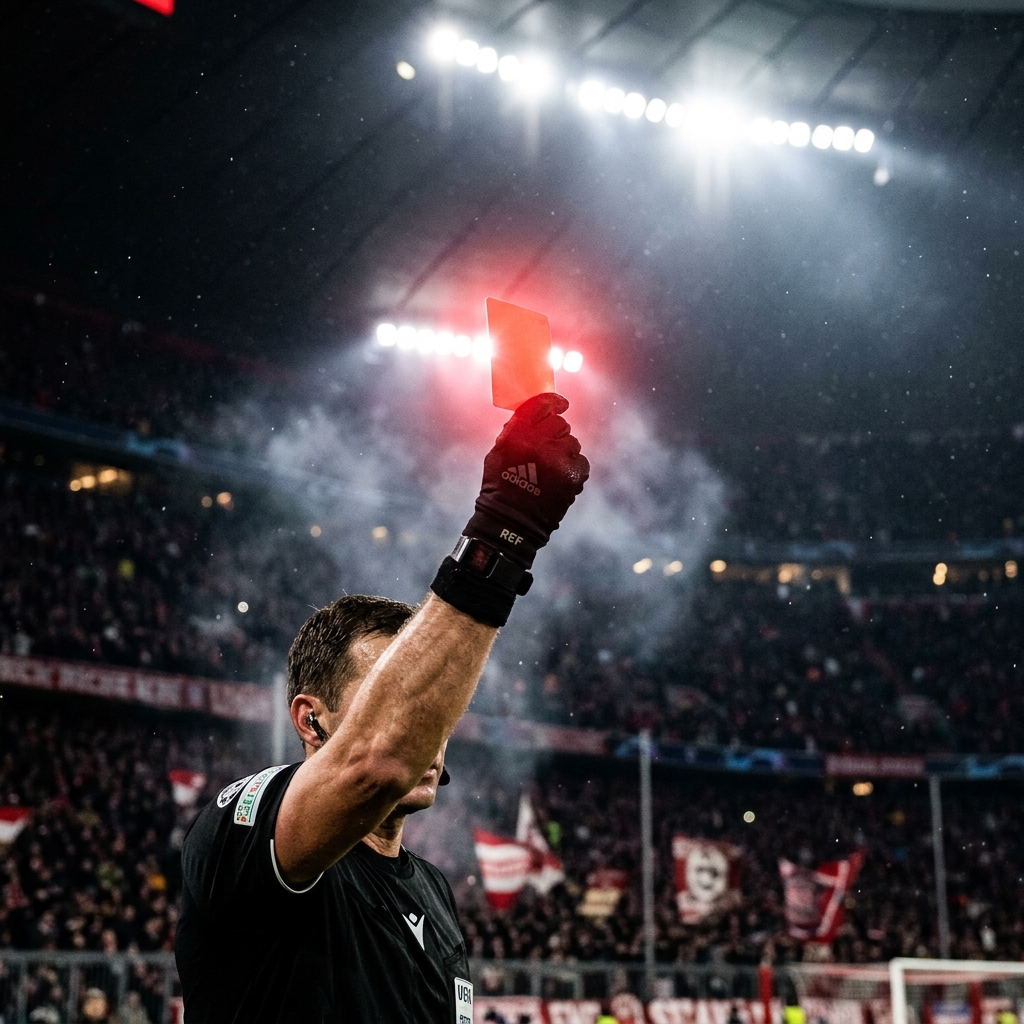
On the football pitch, receiving a red or yellow card is usually seen as the price of making a mistake.
But have you ever noticed that some players walk off the pitch after receiving a red card with an expression of calm “mission accomplished” on their face?
In the world of professional football, red and yellow cards are not just tools for referees to maintain order — they are more like a form of “tactical investment.”
Today, let’s break down the dark arts of the football pitch and see why sometimes “getting carded” is actually the key to securing victory.
The “Stamina Black Hole” of Playing with One Less: Why Is a Red Card So Deadly?
When a player receives a red card and is sent off, the team faces much more than simply “losing one player.” It’s the beginning of a chain reaction:
| Impact | Specific Details |
|---|---|
| Stamina Black Hole | A football pitch is enormous — 11 players running is just right, but 10 players running is a disaster. The remaining players must cover roughly 10% more distance to fill the gap left by the red card. By the final stages of the match, the entire team cramping up and collapsing from exhaustion is a common sight. |
| Tactical “Amputation” | If one of your defenders gets a red card, the coach typically has to reluctantly substitute a star striker for a workhorse defender to fill the gap. This essentially means giving up attacking firepower entirely, leaving the team to absorb pressure passively for the rest of the match. |
This is why, in most cases, a red card is every coach’s worst nightmare.
Investment and Sacrifice: When a Red Card Becomes a “Bargain Deal”
If the cost is so high, why do players still commit deliberate fouls?
This is what’s known as the “Tactical Foul.”
The most classic scenario is this: The match is in the 90th minute, and the opponent’s striker has beaten everyone to create a one-on-one scoring chance. At this point, you pull him down from behind — yes, you’ll receive a “red card + suspension” package, but you’ve traded it for the chance that the opponent misses the penalty kick, or you’ve preserved your 1-0 lead.
From this “ultimate pragmatist” perspective, that red card is a form of “sacrifice play.”
Although it goes against the spirit of sportsmanship, in the real world of professional sports, it is considered a calculated and precise decision.
| Foul Type | Tactical Purpose | Expected Cost |
|---|---|---|
| Tactical Foul (SPA) | Disrupt the opponent’s potential attacking opportunity | Yellow card |
| Denial of Obvious Goal-Scoring Opportunity (DOGSO) | Prevent a clear and obvious goal-scoring chance | Red card + suspension |
The “Psychological Pressure” of a Yellow Card: Do You Still Dare to Defend Aggressively?
A yellow card may seem like just a warning, but it puts the defending player into a state of “credit alert.”
Imagine driving in front of a police officer — you definitely wouldn’t dare speed. Once a defender picks up a yellow card, every subsequent move becomes extremely cautious, terrified that one slip-up will turn “two yellows into a red.”
At this point, the opponent’s striker feels as comfortable as being in their own kitchen, because they know you don’t dare engage them in physical challenges.
This invisible psychological shackle is often harder to deal with than playing with one fewer player.
Dark Arts: Have You Heard of “Card Scrubbing” Tactics?
To cope with a long season, professional teams have an unwritten rule known as “Card Scrubbing.”
Suppose a star player has already accumulated 4 yellow cards, and one more means a suspension. The upcoming schedule looks like this: the next match is against a weak team, and the match after that is against their arch-rivals.
At this point, the player might deliberately pick up their 5th yellow card in the match against the weak team for something trivial like “time-wasting.”
This way, they serve their suspension “vacation” during the weak team match, and by the time the crucial clash against their rivals comes around, their yellow card record has been wiped clean, allowing them to go all-in without any worries.
Even in World Cup tournaments with short schedules, the rules stipulate that yellow cards are “reset” after the quarter-finals, specifically to protect star players from missing the final due to accumulated yellow cards, ensuring viewership and entertainment value.
Summary: More Than Just Rules — An Extension of Strategy
The red and yellow card system was inspired by Ken Aston, a referee who noticed traffic lights, with the purpose of breaking through language barriers and maintaining fairness.
But in modern football, it has evolved into an extension of psychological warfare and strategy.
Next time you watch a match, when you see a player commit what seems like a “baffling” foul or action, don’t rush to criticize them for being reckless. What lies behind it might just be the deepest tactical calculation from the coaching staff!