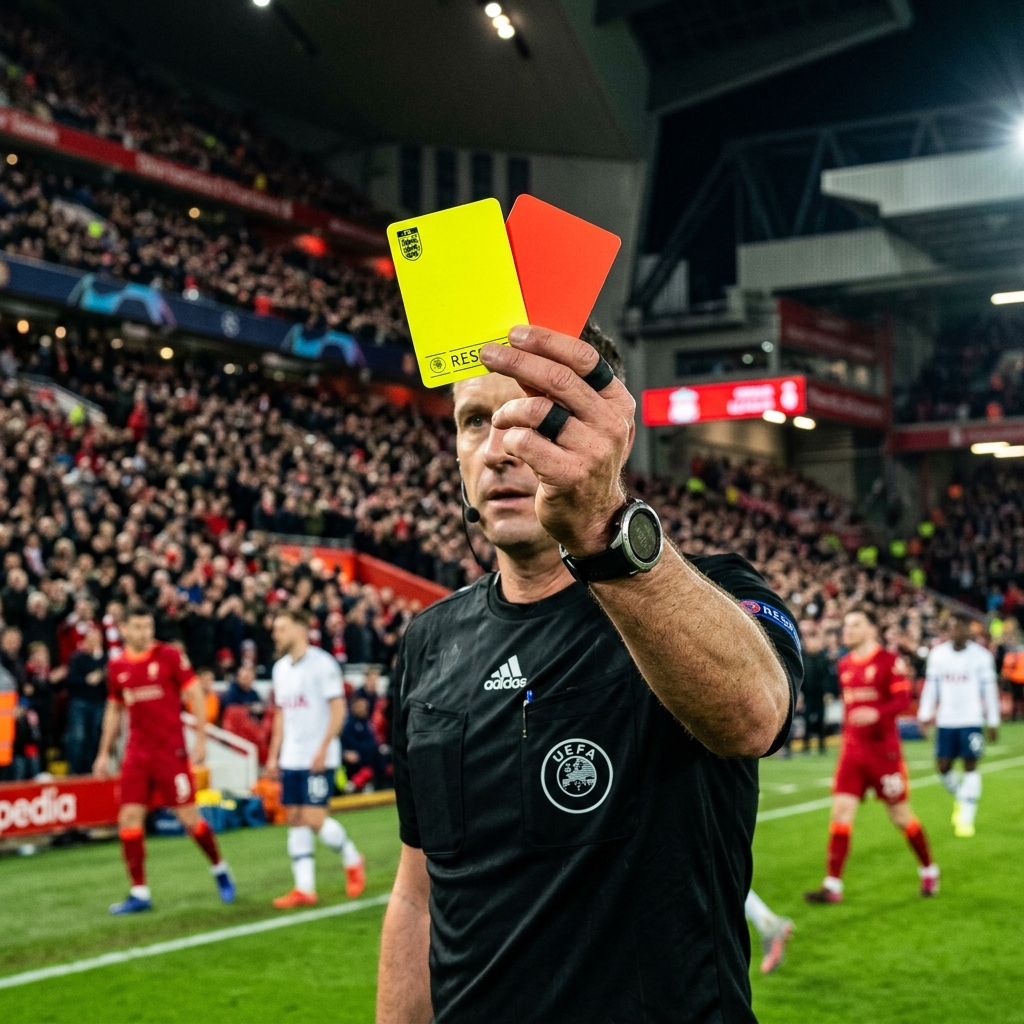
Every time the World Cup or Champions League Final comes around, you probably hear commentators saying things like: “If this player gets another yellow card today, he’ll be suspended for the next match!” Or you see the referee pulling out two cards on the same player — first yellow, then red — sending him off.
So how exactly do yellow card suspension rules work? Why do some players get two yellows without being sent off the pitch, while others end up banned for three consecutive matches? Let’s break down football’s “credit system” so you can finally understand the tactical calculations behind every coaching decision.
Two Parallel “Penalty Systems”: Pay Now vs. Long-Term Credit
To understand suspensions, you first need to distinguish between two completely different systems. Think of them as the difference between “paying on the spot in installments” and “long-term credit lending”:
1. Same-Match “Installment Payment”: Two Yellow Cards Become One Red
This is the rule everyone knows best. If a player receives a second yellow card within the same match, the referee will immediately follow up with a red card.
| Item | Explanation |
|---|---|
| Logic | You’ve already been warned once (first yellow card), yet you committed another “reckless” mistake. This means the warning was ineffective, and the accumulated misconduct has reached the level of “you can no longer stay on the pitch”. |
| Consequence | Immediate ejection (playing with one fewer player), and an automatic one-match suspension. |
| Fun Fact | In the statistics, this is recorded as “one red card (converted from two yellows)” rather than two yellow cards! |
2. Cross-Match “Long-Term Credit Default”: Accumulated Yellow Cards
This applies to “individual yellow cards” received across different matches. Yellow cards don’t just disappear — they follow your player record.
| Item | Explanation |
|---|---|
| Logic | It’s like traffic violation points — park illegally today (one yellow card), speed next month (one yellow card), and once you hit the limit, the authorities will “suspend your license” for a while. |
| Threshold | It depends on the “tolerance level” of each competition format. |
World Cup vs. Professional Leagues: The Rules Are Very Different!
Every league and cup competition has a completely different tolerance for yellow cards, and this is where fans get most confused:
| Competition Type | Accumulation Threshold | Suspension Rules & Features |
|---|---|---|
| World Cup (FIFA World Cup) | 2 cards | Extremely strict. Get 2 in the group stage and you’re suspended. To protect the quality of the final, cards reset after the quarterfinals. |
| Champions League (UEFA Champions League) | 3 cards | Moderately strict. Every 3 accumulated cards results in a one-match suspension. |
| Premier League | 5 cards | More lenient. 5 cards in the first 19 matches means a 1-match ban; 10 cards in the first 32 matches means a 2-match ban. |
| International Qualifiers | 2 or 3 cards | Varies by continental confederation. If suspended in the last qualifying match, the ban carries over to the tournament proper. |
Why Do Yellow Cards Reset After the World Cup Quarterfinals?
This is a very practical mechanism. In the past, star players received their second yellow card in the semifinal, preventing them from playing the final, which seriously affected viewership ratings and match quality.
The current rule clears all yellow card records after the quarterfinals, so unless you receive a “straight red card” in the semifinal, all the big stars are guaranteed to appear in the final.
Professional Players’ “Dark Arts”: Card Scrubbing Tactics
Since yellow cards accumulate, coaches and players engage in a psychological game called “Card Scrubbing”:
Imagine a star center-back has already accumulated 4 yellow cards (one more and he’s suspended). The next match is against a very weak opponent, but the match after that is against the league leaders — their arch-rivals.
In this scenario, the player might deliberately pick up a yellow card for “time-wasting” or “talking back to the referee” during the match against the weaker team.
The result: He reaches exactly 5 yellow cards, gets suspended for the “easy” match as a “vacation”, and by the time the crucial match against the top team arrives, his yellow card record has been wiped clean — he can defend aggressively without any worries.
Advanced Hidden Rules You Might Not Know
Beyond basic accumulation, football rules contain several fascinating “deep details”:
1. The “Amnesty” During Penalty Shootouts
Here’s a fun fact: Yellow cards during penalty shootouts are counted separately.
If you received a yellow card during regular time and then got another yellow card during the penalty shootout for interfering with an opposing player, this does NOT become a “two yellows equal one red” situation — you won’t be sent off. This is because penalty shootouts are considered a special procedure after the match has ended.
2. Yellow Cards Alone Can Decide Your Fate: Fair Play Rules
In the 2018 World Cup, Japan and Senegal were tied on points, goal difference, and head-to-head record. In the end, Japan qualified for the Round of 16 because they had “two fewer yellow cards than Senegal”, advancing solely through the “Fair Play Score”.
This was the first time in World Cup history that qualification was determined by yellow cards.
3. The Suspension Gap Between “Straight Red” and “Two Yellows to Red” Is Enormous
In many leagues, if a player is sent off due to “two yellow cards becoming one red card”, the punishment is usually only a one-match suspension.
But if the red card was given for violent conduct as a “Straight Red”, the ban often starts at three matches and can even be extended with additional sanctions.
Summary: Know the Rules, Watch Like a Pro
Once you understand the accumulation logic of red and yellow cards, you’ll be able to accurately predict why a coach substitutes a player who’s already on a booking when the team is leading, or why players sometimes commit seemingly unnecessary fouls.
The rules aren’t just about punishment — they’re part of football’s “grand chess game,” involving strategic calculations about credit, risk, and consequences!