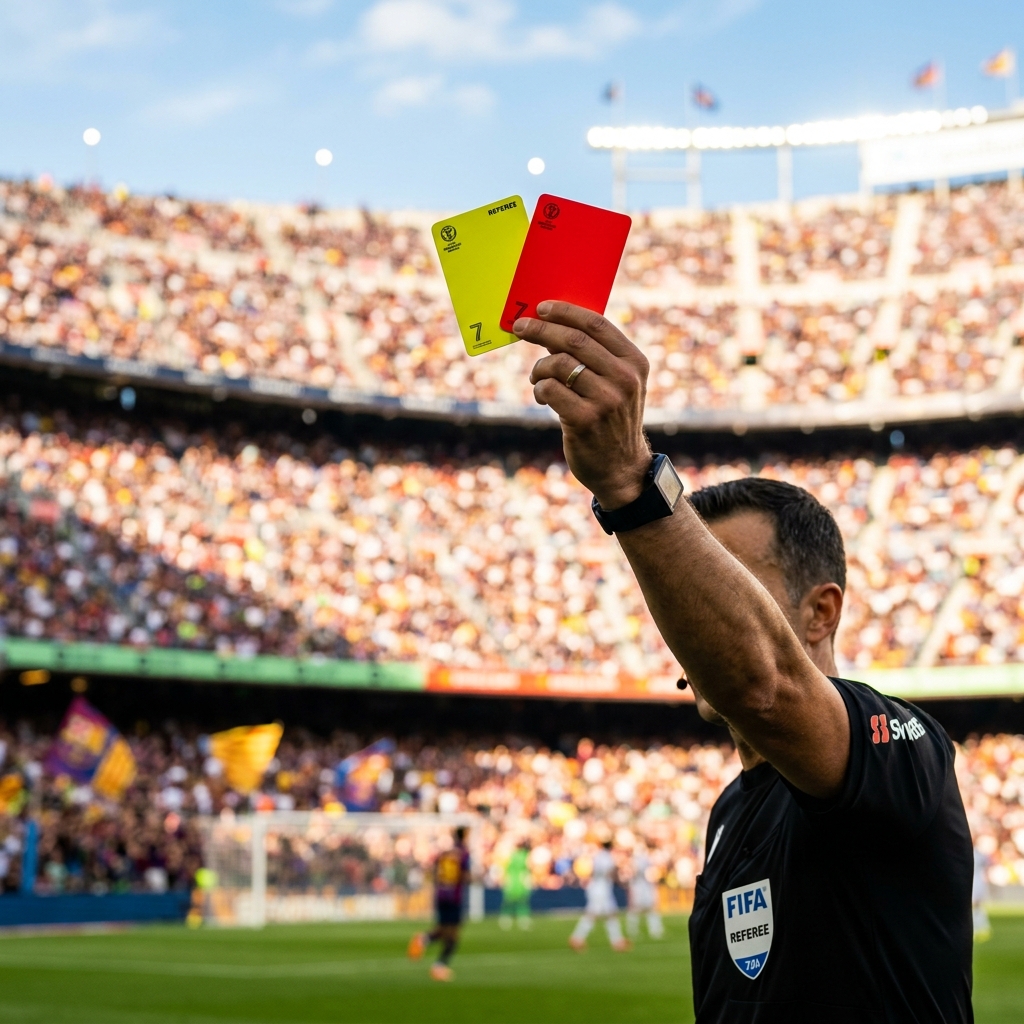
Every time the World Cup or a major tournament comes around, have you ever had this kind of confusion while watching a match with friends:
“Why did the referee do nothing when that player crashed into someone so hard just now? But then a slight tug on the jersey gets a yellow card?”
The Fascinating Origin of Yellow and Red Cards: Inspired by Traffic Lights?
Before the 1960s, there were no yellow or red cards in football. Back then, if a referee wanted to send a player off, they had to do it verbally.
Imagine an international match where the referee speaks English and the players speak Spanish — when neither side understands the other, the scene would become extremely chaotic.
The hero who solved this problem was English referee Ken Aston. One day while driving and waiting at a red light, he looked at the traffic signal and had a sudden flash of inspiration:
“Yellow means caution (slow down), red means stop (no entry)” — isn’t this a universal language understood worldwide?
And so, the yellow and red card system officially debuted at the 1970 FIFA World Cup in Mexico, becoming the most iconic enforcement symbol on the football pitch ever since.
The Referee’s Mental Scale: The “Three-Level” System of Punishment
Think of the referee as the “traffic police of the pitch.”
When physical contact occurs between players, the referee categorizes fouls into three levels based on the severity of the action:
| Severity | Decision | Everyday Analogy | On-Pitch Situation |
|---|---|---|---|
| Careless | Foul only, no card | Like rushing through a supermarket and accidentally stepping on someone’s foot. You didn’t do it on purpose and had no intent to harm. | A simple trip or push with little force, where the target was the ball but the player misjudged the action. The referee will only blow the whistle and award a free kick to the opposing team. |
| Reckless | Yellow card warning | Like speeding and weaving on the road. You haven’t hit anyone yet, but you knew it was dangerous and did it anyway. | The player charges in with complete disregard for the consequences, using excessive force. Even though the opponent may not be seriously injured, this is an act of “ignoring danger” — the referee will pull out the yellow card and write your name in the book. |
| Excessive Force | Straight red card | Like swinging a baseball bat at someone on the street with intent to harm. This is no longer a mistake — it’s endangering someone’s safety. | A studs-up flying tackle, an elbow to the opponent’s head, or deliberate harm. This endangers the opponent’s safety, and the referee will not hesitate to pull out the red card and ask you to leave the pitch immediately. |
No Blood but Still Got Carded? Those “Unsportsmanlike” Little Moves
Beyond rough physical play, there are some “non-violent” behaviors on the football pitch that undermine fairness and can also earn you a card:
| Situation | Explanation |
|---|---|
| Time-wasting | Deliberately delaying the restart when your team is ahead, or walking off the pitch at a snail’s pace when being substituted. |
| Diving (Simulation) | Falling down dramatically in the penalty area despite no contact, attempting to trick the referee into awarding a penalty kick. |
| Excessive celebration | Getting too excited after scoring and taking off your jersey — this is an automatic yellow card in official matches. |
| Denying an Obvious Goal-Scoring Opportunity (DOGSO) | When an opponent is through on goal in a one-on-one situation and about to score, but you commit a foul from behind to stop them — the referee will dish out the “combo” of a red card plus a penalty kick. |
Conclusion: Guardians of Fairness and Safety
Referees don’t give cards based on mood — they do it to protect players’ safety and ensure the match is played under fair rules.
Next time you watch a match and see the referee reaching for their pocket, you’ll be able to predict like a savvy fan whether it’s going to be a “Reckless” or “Excessive Force” call!