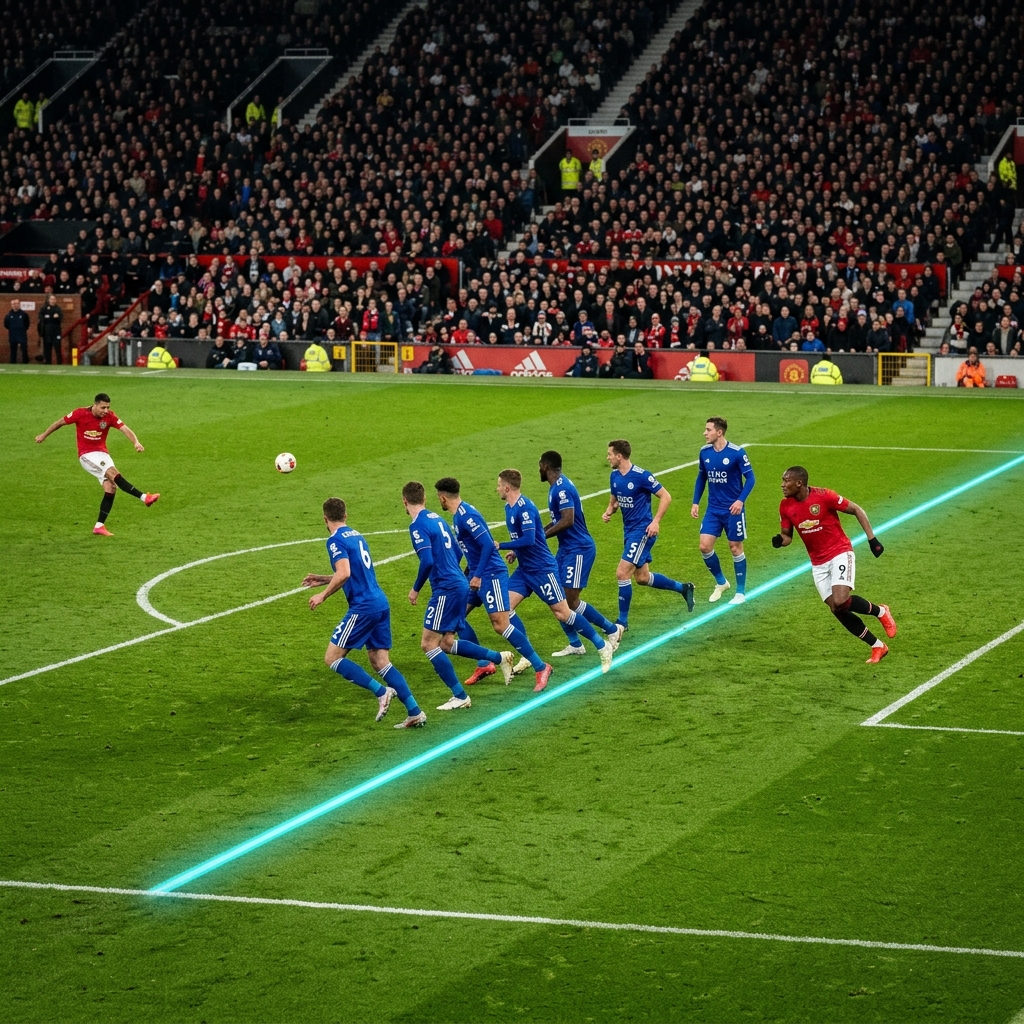
Football is not just a battle of physicality and skill — it’s a high-IQ psychological game. If you’ve ever watched a match, you’ve surely seen this scenario:
A striker is about to celebrate a goal, but the linesman raises the flag — the entire stadium goes silent in an instant.
This is the “offside” rule that frustrates countless strikers and brings relief to defenders.
For top professional teams, offside isn’t just a restriction to prevent players from “cherry-picking” — it’s the most thrilling, most mind-bending tactical weapon in the entire match.
The outcome of the entire game often comes down to that 0.1-second battle on the “offside line.”
The Offside Rule: The Defense’s “Invisible Line”
The offside rule requires that at the exact moment a teammate passes the ball, the attacking player must have at least 2 opponents ahead of them (usually including the goalkeeper).
The original purpose of this rule was to prevent players from permanently camping in front of the opponent’s goal, turning the game into a boring long-ball fest.
But in modern football, this “restriction” has evolved into a proactive tactical weapon.
The defending side is no longer passively waiting for offside to happen — instead, they actively use this invisible line to counter their opponents.
Three Keys to Judging Offside
To determine whether a player is offside, you can’t just look at where they’re standing — you must observe three core elements at that specific “split second.”
| Key | Focus | Explanation |
|---|---|---|
| Timing | The exact moment a teammate “kicks the pass” | This is the most crucial key! Offside is judged not when you receive the ball, but at the moment your teammate’s foot touches the ball — that 0.1-second window. If you haven’t jumped ahead when your teammate kicks the ball, even if you later accelerate past defenders to receive it, the play is still a legal and brilliant attack! |
| Spatial Position | There must be “two” defenders ahead | At the exact moment your teammate passes, there must be at least 2 opponents between you and the goal. Usually, these two are “one goalkeeper + one defender.” If you rush too far forward, leaving only the goalkeeper between you and the goal, or even leaving the goalkeeper behind you, then you’ve “jumped the queue.” |
| Level of Involvement | Did you “interfere with play”? | If you’re just standing in an offside position doing nothing, the ball goes to a teammate on the other side, or you made no attempt to play the ball or block the goalkeeper’s line of sight, the referee usually won’t blow the whistle. This is what’s known as “being in an offside position but not committing an offside offense.” |
The Offside Trap: The Ultimate Display of Team Chemistry
When the defending side notices the attacking side is about to play a threatening through ball, the four defenders will, with perfect synchronization, collectively step forward within 0.1 seconds of the opponent’s kick!
This is the legendary “Offside Trap.”
Imagine this: a striker who was ready to receive the ball and sprint forward suddenly realizes, at the moment the pass is played, that there’s not a single defender in front of them anymore. They think they’ve got the perfect “one-on-one” opportunity, but in reality, they’ve already fallen into the offside trap.
This requires extremely high chemistry and precise timing judgment between defenders — if even one person fails to step up, the trap turns into a gift-wrapped opportunity for the opponent.
The Art of Anti-Offside: Surviving Like a Cheetah
Where there are traps, there are always ways to break them. What elite strikers excel at most is the “Anti-Offside” technique.
They don’t just stand behind the defensive line like sitting ducks — instead, like cheetahs, they constantly move laterally beside or behind the defenders, searching for that “critical point.”
Elite strikers watch for their teammate’s subtle kicking motion and only burst into an explosive sprint past the defensive line within that 0.1-second window when the foot touches the ball.
This instinct for “living on the edge of offside” allows them to be at the exact parallel position the instant defenders push forward, using their speed to tear through the defensive zone.
This isn’t a simple footrace — it’s the ultimate test of spatial and temporal awareness.
When It’s “Not Offside”: Special Exemption Clauses
Although the offside rule is strict, football has also designed some “balancing mechanisms” to keep the game more fluid. In the following situations, even if there’s no one ahead of you, you absolutely won’t be called offside:
| Situation | Everyday Analogy | Why Doesn’t It Count? |
|---|---|---|
| In your own half | Running freely in your own backyard | You haven’t crossed the halfway line, so it doesn’t count as invading enemy territory. This encourages teams to launch quick counterattacks. |
| Throw-in | A hand-delivered gift | The accuracy of throwing a ball by hand is limited. Without this exemption, the defending side could just step back a bit, and no one on the attacking side could receive the ball. This is also why throw-ins near the penalty area get so physical — defenders know they can’t use the trap to catch you, so they have to fight tooth and nail in close combat. |
| Corner Kick | Nowhere left to retreat at the end line | During a corner kick, the ball is already at the very end line. By definition, any receiver is closer to the goal than the ball, so offside naturally doesn’t apply. |
| Goal Kick | A big-boot reboot | This allows a besieged team to catch their breath, preventing the opposing strikers from blocking every long-pass route. |
The Offside Line: The Invisible Line Between Life and Death
The offside line is the line between life and death on the football pitch. Every centimeter that attack and defense fight over on this line is filled with deception, anticipation, and reaction.
Next time you watch a match, don’t just follow the ball. Try observing the collective movement of the defensive line and the striker’s eager timing to make a run — you’ll discover that this “0.1-second battle” is the most captivating tactical charm of modern football.