Whether you’re scuba diving, swimming at the beach, or taking a boat trip, people usually worry about sunburn and big waves.
But have you ever considered that “water temperature” can also be a deadly threat?
Many people think that as long as the seawater isn’t freezing, staying in it longer won’t hurt.
But in reality, even in 20℃–24℃ seawater that feels “pleasantly cool,” just 2 hours of exposure can leave you violently shivering and mentally confused, entering a severe state of ocean hypothermia.
So why does falling into the sea cause you to lose body heat so fast? And if you’re unlucky enough to end up overboard, what should you do to survive until rescue arrives?
Why Is Seawater More Deadly Than Air? Unlocking the Secret of 25x Heat Conduction
If you’re standing in a 15℃ air-conditioned room, you might just feel like you need a light jacket.
But if you’re submerged in 15℃ seawater, you could face life-threatening danger in under 6 hours.
The key reason lies in this:
Water conducts heat 25 times faster than air!
When you enter seawater, your 37℃ body is essentially placed into a massive “heat sink” — the 20℃ seawater aggressively “sucks” your body heat away.
This is why even if the seawater doesn’t feel icy, it drains your heat so fast that your heart, brain, and other vital organs can quickly “shut down” from overcooling.
The Deadly Fashion Show of Ocean Hypothermia: Body Temperature and Symptoms
As your core temperature drops, your body goes through the following stages:
| Core Temperature | Condition |
|---|---|
| Below 35℃ | Hypothermic collapse begins — you start feeling extreme fatigue and mental confusion. |
| Below 31℃ | Loss of consciousness; your body stops shivering (because energy reserves are depleted). |
| Below 28℃ | Blood vessels stiffen; your heart may stop beating. |
| 24℃–26℃ | The fatal threshold — this typically leads to death. |
The Key to Overboard Survival: Never “Swim for Your Life”!
Many people’s first instinct is:
Jump in the water and swim hard — moving around will generate heat.
This is wrong! And extremely dangerous!
Swimming frantically in cold water causes blood to rush to your limbs, which actually makes your core (heart, brain) lose heat even faster.
Unless you’re very close to shore or a lifeboat, you should stay still and conserve your energy and body heat.
The Deadly First Challenge: Cold Shock and the 1-10-1 Survival Rule
The moment your skin hits freezing water, your body triggers a “Cold Shock Response”.
This is an instinctive physiological reaction — your brain goes into panic mode, causing your diaphragm to spasm, creating a dangerous “gasp reflex”.
If you happen to be underwater with your mouth open, seawater will flood directly into your lungs.
To deal with this extreme situation, survival experts developed a life-saving hourglass: the “1-10-1 Survival Rule”.
| Time | Objective | Status |
|---|---|---|
| 1 Minute | Control your breathing | In the first 60 seconds after falling in, your only goal is “stay alive and let your brain reboot”. Don’t rush to swim — first get your breathing under control to prevent the gasp reflex from causing drowning. |
| 10 Minutes | Take critical action | While your muscles still work, quickly put on a life jacket, find something to float on, or send a distress signal. After 10 minutes, blood will retreat to your core, and your limbs will rapidly go numb, making you as clumsy as a wooden puppet. |
| 1 Hour | Maintain the HELP position | If you’re wearing a life jacket, your next mission is to enter “survival power-saving mode” — stay still, wait for rescue, and fight the hypothermia threshold. |
How to “Manually Restart” Your Breathing?
When facing cold shock, you can use “exhaling” to forcefully regain control. Exhaling forcefully and slowly stimulates your vagus nerve, telling your heart:
“Slow down — we’re not done yet.”
| Method | Description |
|---|---|
| Sharp Hissing Method | Make a “hiss” sound to narrow the airway exit and increase chest cavity pressure. |
| Pursed-Lip Breathing | Breathe out like you’re blowing out a candle — this is the most effective way to lower your heart rate. |
Essential Survival Move: The HELP Position
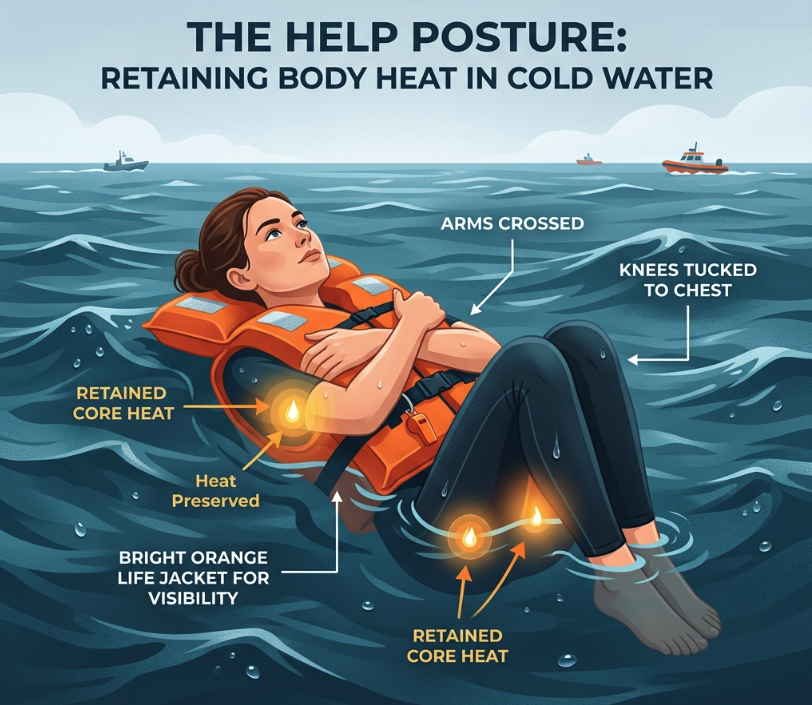
If you’re wearing a life jacket, immediately adopt the internationally recognized HELP Position (Heat Escape Lessening Posture):
| Action | Purpose | Goal |
|---|---|---|
| Press both elbows tightly against your sides | Protect your armpits | Seal off the armpit heat-leak zones |
| Bend and press your knees together | Protect your groin (inner thigh area) | Seal off the groin heat-leak zones |
| Cross your arms over your chest | Lock in core body heat | Reduce contact area with seawater to slow down heat loss |
Why protect your armpits and groin?
Because these areas have major blood vessels passing through them with thinner skin, making them the body’s “heat leak black holes”.
Clamping these areas tight is like putting on an invisible wetsuit for your body.
If multiple people fall overboard together, adopt a group huddle approach: everyone stands shoulder to shoulder in a circle, hugging each other — this significantly reduces contact area with cold water and greatly extends survival time.
Making Search and Rescue See You: The Magic of “3” at Sea
In the vast ocean, search and rescue personnel looking for a person overboard is like playing “Where’s Waldo” — a needle in a haystack.
So you must actively send distress signals. Remember the universal maritime distress code “3”:
| Action | Description |
|---|---|
| Blow a whistle 3 times | One-second intervals between blows — this is the most energy-efficient audible signal. |
| Flash light 3 times | Use a signal mirror or flashlight, aiming at rescue aircraft or vessels. |
| SOS rhythm | Three short, three long, three short (... --- ...). |
“Equal length, equal spacing, repeated 3 times” is a pattern that almost never occurs in nature.
So when search and rescue personnel hear this sound, they instantly know it’s a distress signal.
First Aid Taboos After Rescuing a Hypothermia Victim: Never Give Them Alcohol!
After a hypothermia victim is rescued ashore, wrong first aid methods can cause secondary harm. Remember these principles:
| Wrong Approach | Explanation |
|---|---|
| No alcohol | Alcohol causes capillaries to dilate, which actually accelerates heat loss, and sends cold blood from the extremities rushing back to the core, putting dangerous strain on the heart. |
| No rubbing the limbs | Massaging a hypothermia victim's hands and feet will force ice-cold blood from the extremities back to the heart, potentially triggering fatal cardiac arrhythmia (known as “rewarming shock”). |
| No localized heating | A severely hypothermic person’s skin is insensitive to heat — localized heating can very easily cause burns. |
Correct Rewarming Steps
| Correct Approach | Explanation |
|---|---|
| Remove wet and cold sources | Immediately cut off and remove wet clothing, dry the body and change into dry clothes. |
| Wrap the core | Use blankets or sleeping bags to wrap the entire body, especially the head, neck, chest, and abdomen. |
| Provide warm drinks | If the victim is conscious, offer warm milk or sweetened warm water to replenish energy. |
| Hot bath precautions | If the hypothermia victim’s body is rewarming and they are conscious, you may try immersion in 40℃–45℃ hot water for no more than 10 minutes, while closely monitoring body temperature changes. |
Conclusion: Always Bring a Life Jacket and Whistle When Going to Sea — Getting Home Safely Is the Only Way
Ocean hypothermia is the sea’s “invisible killer.” No matter how good a swimmer you are —
Facing heat conduction 25 times faster, the human body is fragile.
When heading out to sea, please always wear a life jacket, check your whistle, and memorize the “1-10-1 Survival Rule” and the “HELP Position”.
In case of an accidental fall overboard, staying calm, conserving heat, and sending precise distress signals are the only rules for survival.
Although none of us ever want to use this knowledge, it might be your last life-saving card in the future.
More knowledge means more chances of surviving at sea!
Set sail with joy, return home safely.