You turn off the lights at midnight, ready to sleep, when suddenly you hear a buzzing sound near your ear — sometimes close, sometimes far. You angrily jump up and turn on the lights, ready to fight this uninvited guest to the death, only to find it has vanished without a trace.
That maddening frustration is just the tip of the iceberg when it comes to its threat. According to the World Health Organization’s 2023 statistics, this tiny flying insect kills over 700,000 people worldwide every year by spreading diseases , firmly holding the top spot as the deadliest animal on Earth.
Have you ever thought that this little creature you hate so much has actually been living on Earth for over 130 million years ?
And its blood-sucking method is far more sophisticated than you might imagine.
What Were Mosquitoes Doing 130 Million Years Ago? Male Mosquitoes Used to Suck Blood Too
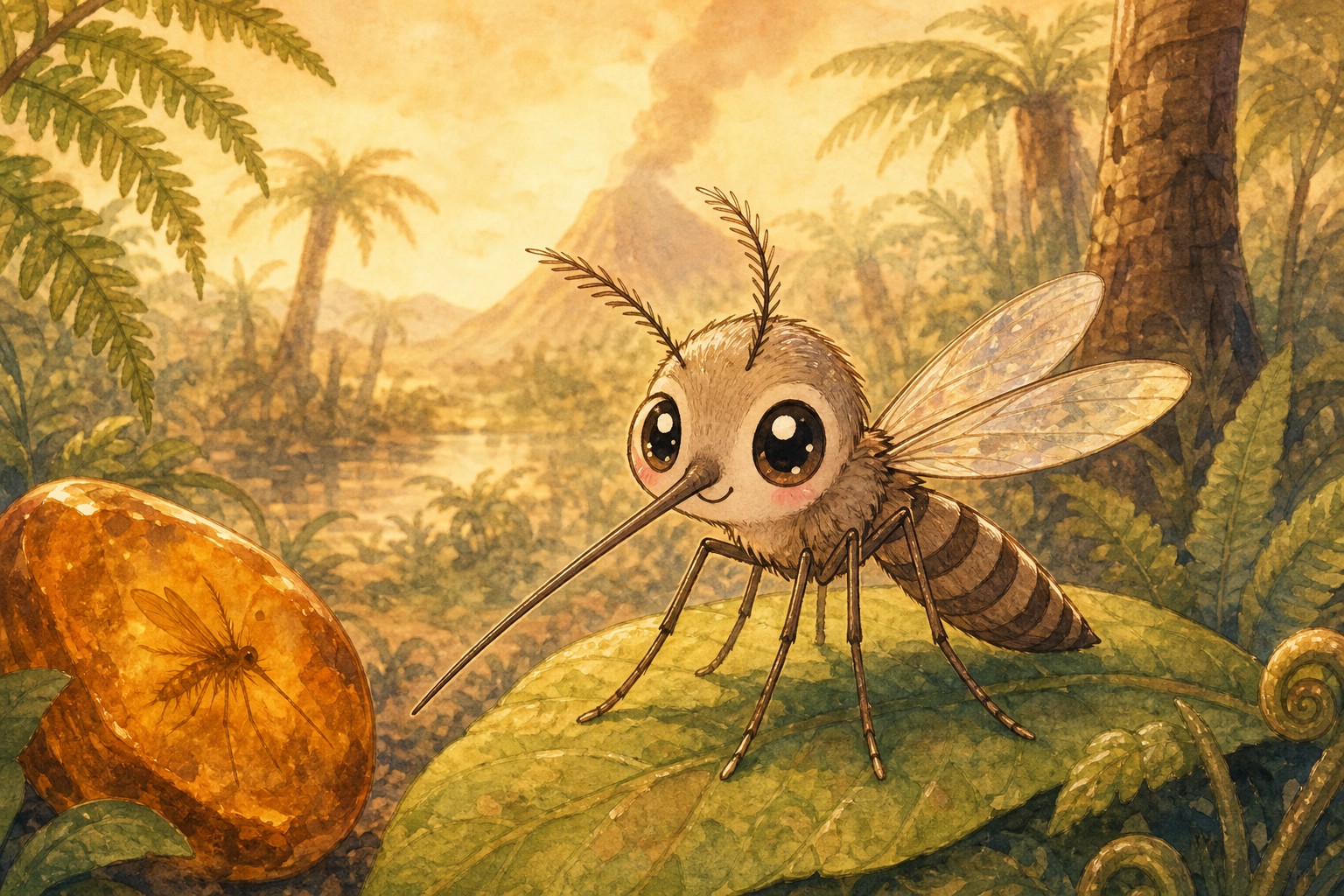
In 2023, scientists discovered a mosquito fossil from 130 million years ago (the Cretaceous period) in a piece of amber from Lebanon. That was an era when dinosaurs still roamed the Earth, and the mosquito’s ancient ancestors were already around.
Even more astonishing, this fossil shattered previous assumptions:
Male mosquitoes back then also had sharp piercing-sucking mouthparts — they sucked blood too.
So why do only female mosquitoes suck blood now?
In fact, mosquitoes suck blood not to survive, but to reproduce
The proteins, iron, and various amino acids in blood are essential raw materials for female mosquitoes to develop their ovaries and lay eggs. Normally, both female and male mosquitoes survive by feeding on flower nectar and fruit juice.
| Period | Male Diet | Female Diet | Reason |
|---|---|---|---|
| 130 million years ago (Early Cretaceous) | Blood | Blood | Flowering plants had not yet flourished; blood was the primary energy source |
| Late Cretaceous to present | Nectar (vegetarian) | Usually nectar, blood before laying eggs | Angiosperms proliferated , nectar provided a safer energy source |
Why Do Mosquitoes Usually Feed on Nectar (Vegetarian)?
Flowers don’t swat mosquitoes.
After all, sipping nectar doesn’t carry the risk of being slapped to death, so male mosquitoes gradually gave up blood-sucking and focused on finding mates. This is essentially a division of labor through evolution.
Mosquitoes Don’t “Stab” When They Bite? The Surgical-Grade Mouthpart of Six Needles
You might think mosquito blood-sucking is like drinking juice through a straw — one needle goes in and starts sucking.
But that single “straw” you see on a mosquito is actually six precision needles with distinct functions , wrapped in a sheath (labium). From a bioengineering perspective, this is essentially a complete surgical tool kit .
| Needle Type | Quantity | Function |
|---|---|---|
| Serrated Needles (Mandibles) | 2 | Use serrations to cut the skin (not puncture — they cut) |
| Bracing Needles (Maxillae) | 2 | Spread the cut wound open to both sides, creating operating space |
| Injection Needle (Hypopharynx) | 1 | Injects saliva containing anticoagulants, vasodilators, and anesthetic compounds |
| Suction Needle (Labrum) | 1 | Responsible for drawing blood, with taste receptors at the tip to detect blood vessel locations |
The entire process works like this:
- The serrated needles first cut open your skin
- The bracing needles spread open the wound, creating operating space
- The injection needle injects saliva; special proteins in the saliva prevent blood from clotting , dilate blood vessels , and even have a local anesthetic effect
- The suction needle’s tip uses taste receptors to detect the taste of blood vessels, only starting to draw blood after locating one
Mosquito saliva has an anesthetic effect, so you don’t feel a thing when you’re being bitten. It’s only after the mosquito has finished feeding and flown away that you start to feel the itch.
Is “Flexing Your Muscles to Trap a Mosquito” Real?
There are some amusing claims circulating online:
- Flexing your muscles hard can lock the mosquito’s mouthparts in place, preventing it from pulling out
- Arterial blood pressure can inflate the mosquito until it explodes
Sounds satisfying, but these are all false .
A mosquito’s mouthparts are extremely short, reaching only the dermis layer, and cannot penetrate the subcutaneous fat to reach muscles or major arteries.
So no matter how hard you flex, it’s impossible to trap a mosquito’s needle with your muscles, and even less possible to make a mosquito explode with blood pressure.
| Internet Myth | Truth |
|---|---|
| Flexing muscles can trap a mosquito | Mouthparts are too short — they can’t even reach the muscle layer |
| Blood pressure can make a mosquito explode | Mouthparts can’t reach major arteries |
| Videos of mosquitoes exploding from blood | Mostly comedic scenes from early silent animations or special effects |
The reason these “exploding mosquito” videos spread so widely is probably because they satisfy humans’ desire for revenge after being bitten.
How Precise Are Mosquito Mouthparts? A Comparison with Human Surgery
If you compare the mosquito’s mouthpart system with human surgical procedures, you’ll find striking similarities:
| Function | Mosquito Mouthparts | Human Surgery |
|---|---|---|
| Cutting tissue | Serrated needles cut the skin | Scalpel cuts the skin |
| Spreading wound open | Bracing needles spread tissue apart | Surgical retractors spread the incision |
| Injecting agents | Injection needle injects anticoagulant saliva | Syringe injects anesthetic |
| Extracting fluid | Suction needle draws blood | Needle draws blood samples |
| Navigation and positioning | Taste receptors detect blood vessels | Ultrasound guides vessel positioning |
A mosquito barely a few millimeters long carries a complete set of micro-surgical tools on its body. And it needs no external equipment — the entire process from cutting, anesthetizing, to drawing blood is completed within seconds .
Next time you’re woken up by a mosquito in the middle of the night, you might feel a bit more awe for its precision “surgical equipment.”