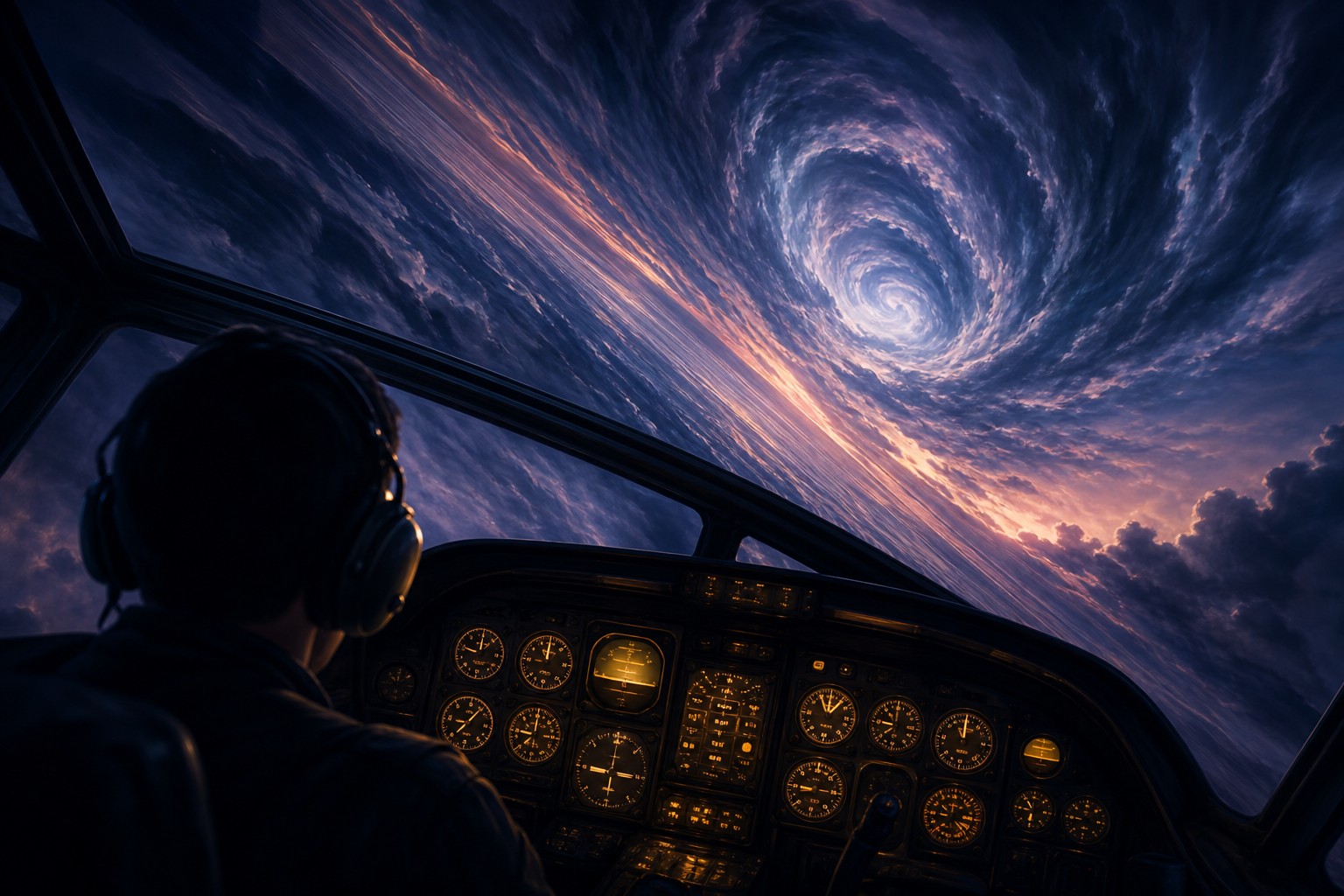
Imagine you are sitting in a chair with your eyes closed, and suddenly you feel like you are doing somersaults. This isn’t a scene from a sci-fi movie, but a real fatal crisis pilots face in the air.
With frequent news of fighter jet crashes in recent years, you might have heard the term “Spatial Disorientation,” but what exactly is it? Why can even highly trained elite pilots not escape it?
What Does Our Body Rely on to Maintain Balance?
The reason we can stand and walk properly without falling is that the brain simultaneously receives signals from three sensory systems:
| Sensory System | Organ | Function | Everyday Analogy |
|---|---|---|---|
| Vision | Eyes | Observe the horizon and ground, confirm orientation | Mobile GPS positioning |
| Vestibular System | Inner Ear | Sense rotation and acceleration, like a liquid leveler | Mobile Gyroscope |
| Proprioception | Muscular Nerves | Feel gravity and pressure, knowing limb positions even with eyes closed | Mobile Accelerometer |
On the ground, these three systems work together perfectly.
But at high altitudes, once entering clouds or darkness and vision fails, the remaining two systems begin to “talk nonsense.”
When the eyes cannot see the horizon, the information transmitted by the inner ear and muscles to the brain becomes “fake data.”
What Happens When the Brain is Tricked?
The most terrifying part of spatial disorientation is:
Your senses will very confidently lie to you.
The feeling of spinning or tilting is incredibly real, and even if the instruments tell you the plane is level, your brain will still scream, “The instruments are broken!”
Here are several classic fatal illusions:
| Illusion Type | Cause | Fatal Consequence |
|---|---|---|
| The Leans | When the plane tilts slowly, the inner ear doesn’t feel it; after a sharp correction, it feels like “the direction of correction is actually tilted” | The pilot continuously corrects in the wrong direction |
| Graveyard Spin | After a prolonged turn, the inner ear fluid settles, giving the illusion of level flight; pulling back to “climb” actually accelerates a spiral descent | The aircraft crashes into the ground without the pilot noticing |
| Black Hole Effect | During night landings with total darkness around, only runway lights are visible, and the brain loses depth perception | Approaching too low, striking ground obstacles |
Spatial disorientation is not a “technical problem” but a “biological betrayal” of your brain.
Why Are Military Aircraft More Prone to Spatial Disorientation Than Civil Aircraft?
You might wonder: Do airliners also experience spatial disorientation? Why do military aircraft often crash?
The answer has a lot to do with “habits.”
| Comparison Item | Military Aircraft (Fighters) | Airliners (Passenger Jets) |
|---|---|---|
| Flight Mode | Over 90% Visual Flight Rules (VFR), performing tactical maneuvers while looking outside | 99% Instrument Flight Rules (IFR), relying on instruments for navigation |
| Reaction to Instruments | During sudden situations, the correction response might be slower | In the first second, they will subconsciously look at the instruments and correct the attitude |
| Training Focus | Fixed on external targets, performing tactical maneuvers | Highly dependent on instruments throughout their career; instrument reaction has become an instinct |
Airliner pilots also encounter spatial disorientation, but because they have spent their whole lives flying by instruments, trust in the instruments has been internalized as a subconscious reaction, allowing them to return to the instruments to correct within the first second.
Even Seas of Clouds and Coastlines Can Lie
What’s even scarier is that sometimes what your eyes see is also fake.
| Visual Trap | Scenario | Dangerous Consequence |
|---|---|---|
| False Horizon | The surface of a sea of clouds is tilted, and the brain subconsciously aligns the plane with the sea of clouds | A plane that was originally in level flight is “corrected” into a tilted attitude |
| Coastline Illusion | Distant coastlines are not parallel to the horizon, mistaken by the brain as the horizontal line | The pilot makes incorrect attitude corrections |
| Acceleration Illusion | Suddenly increasing throttle, closed eyes will strongly feel the plane is climbing | In reality, the plane is just accelerating in level flight |
| Deceleration Illusion | Reducing throttle to slow down, one feels like the plane is falling | The pilot may incorrectly pull back to climb |
Pilots encountering “spatial disorientation” feel like
Entering a cloud, with slanted rain outside, and seeing nothing. The pilot is in great physical pain because the eyes see the attitude indicator saying the plane is level, but the body feels the plane is tilted.
That feeling is not psychological stress; it is a violent physical conflict.
The Only Survival Rule: Trust the Instruments
Since the senses are all lying, what should a pilot do? The answer is only one sentence:
“Trust the Instruments”
When the brain is frantically screaming, “We are falling,” the pilot must desperately suppress instinct and look only at the attitude indicator. This is the iron rule instilled since the first day of flight training, and it remains the only unchanging law of survival.
| Survival Key | Description |
|---|---|
| Trust the Instruments | No matter how the body feels, believe whatever the attitude indicator shows |
| Maintain Altitude | Altitude is time; at 30,000 feet, there is enough space to correct slowly; below 2,000 feet, there is almost no reaction time |
| Avoid Sharp Head Movements | Suddenly turning the head during a turn triggers the Coriolis illusion, making it feel like the plane is flipping instantly |
| Hand Over Control | If there is a co-pilot, directly say “You have control,” let the one who is not disoriented take over |
In the blink of an eye between life and death, the hardest thing to conquer is not the weather, but your own brain.
Tragedies Caused by Spatial Disorientation
Many major accidents in history are related to spatial disorientation:
| Time | Event | Cause |
|---|---|---|
| 2014 | Indonesia AirAsia Crash | Pilot spatial disorientation led to loss of control |
| 2016 | Flydubai Crash | Spatial disorientation |
| 2020 | Kobe Bryant Helicopter Crash | Entering clouds and losing visual reference, spatial disorientation |
These cases cruelly remind us: spatial disorientation is an inherent bug in the human hardware system, regardless of whether it’s military or civil, or how much experience one has; as long as you leave the ground and enter three-dimensional space, this bug could be triggered.
The next time you see aviation news, perhaps you will have a bit more understanding:
In extreme environments, human instincts are not only fragile but even harmful.
And those pilots in the cockpit, staring desperately at the instruments and suppressing all their intuitions, are using reason to fight the brain’s most primitive betrayal.