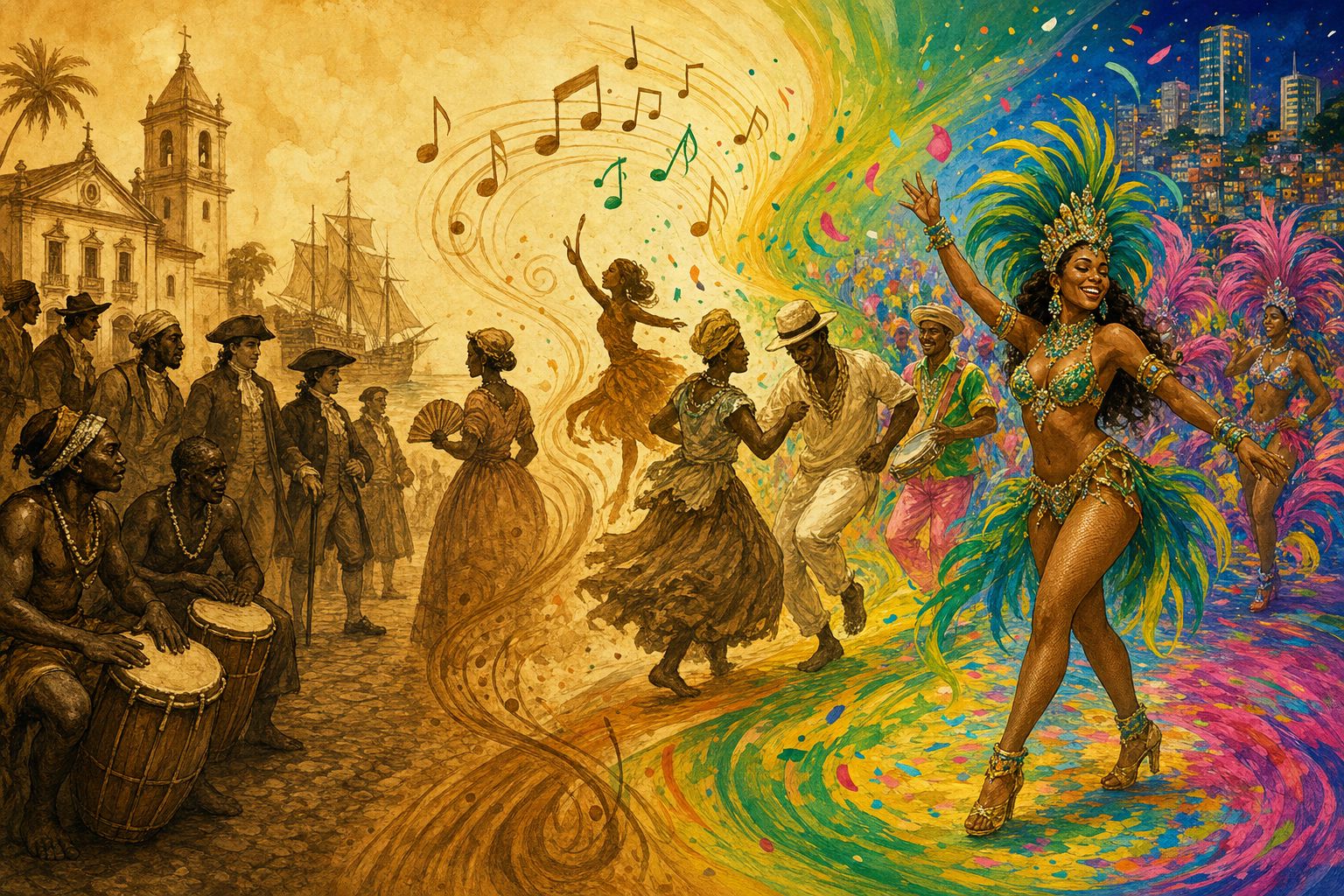
Can you imagine a country with poor public safety and a huge wealth gap, where for five days, people of all classes dance together on the streets with no reservations?
This is not a scene from a utopian novel, but something that actually happens in Brazil every year between February and March.
Behind this madness lies a two-hundred-year history of evolution from a “water prank” to a “national spiritual totem”.
The Hybrid Origin of Carnival: European Framework Meets African Soul
The Brazil Carnival was not invented by a single genius; it is a hybrid born from the intense collision of European Catholic traditions and African slave culture.
The “Water Festival” Prank of the Portuguese
In the 17th and 18th centuries, Portuguese colonizers brought a tradition called Entrudo to Brazil. This was a legally permitted street water fight where people splashed water, threw flour, and hurled rotten tomatoes at each other.
Why do this? Because the next day marks the beginning of the Catholic “Lent” (the 40-day fasting and self-restraint).
The word Carnival literally means “farewell to meat” in Latin, so if you don’t go crazy today, there is no chance to do so for the next 40 days.
The essence of Carnival is the last full indulgence before self-discipline begins.
The Only Days Slaves Were Allowed to “Be Themselves”
Later, African slaves sold to Brazil joined this festival. For slaves living a hellish life, Carnival was the only few days of the year they were allowed to temporarily put down their chains.
They brought:
- African traditional drum rhythms
- Tribal circle dance rituals
- Mask culture and role-playing
They would even boldly “portray” slave owners in the celebrations to mock them.
While their bodies were enslaved normally, their souls were free during these few days.
After the two fused, street water fights became musical parades, eventually birthing Brazil’s soul music, Samba, in the early 20th century.
The Rise of Samba: From “Crime” to National Totem
Originally belonging to the bottom-class Samba rhythm, it went through a dramatic history from being despised to being embraced.
The legally banned “Hooligan Music”
In the early days, Samba originating from Black communities was regarded as crime and hooliganism by Brazilian law, and those who played Samba rhythms could be arrested.
The culture of the lower-class communities was viewed by mainstream society as “vulgar” and “dangerous”.
From Favelas to Mainstream
| Time | Milestone |
|---|---|
| 1928 | The first “Samba School” was established in the favelas |
| 1932 | Rio hosted the first official Samba School Competition |
| 1930s | President Getúlio Vargas promoted national integration and incorporated Samba as a national cultural symbol |
| 1984 | The Sambadrome (Sambódromo), designed by master architect Oscar Niemeyer, was officially completed |
| Modern | Samba became a national calling card that Brazil showcases to the world |
A rhythm that once landed people in prison has now become a cultural totem that makes the entire nation proud.
The development path of Samba is:
Pre-religious festival → Community rhythm → National symbol → Global cultural brand
The Big Reshuffle of Social Classes: Five Days and Four Nights of “Limited-Time Equality”
Brazil is a country with an extremely wide gap between the rich and the poor, with favelas on the hills and super luxury mansions at the foot of the hills.
But during Carnival, this social structure experiences an incredible reversal of status.
Janitors Become Kings, Politicians Become Spectators
| Normal Roles | During Carnival |
|---|---|
| Janitors cleaning luxury mansions | Wear king costumes and stand atop floats receiving cheers from the crowd |
| Car repair workers | Put on dazzling dancer outfits and shine in global broadcasts |
| High-and-mighty rich politicians | Sit in the stands as spectators, applauding the talents of the lower class |
Freedom Across Race and Gender
During Carnival, everyone can cross the boundaries of class, race, and gender, dressing up as any character they dream of.
During these “short five days”, people are no longer bound by social pressures and can release their true selves.
Carnival is a public moment of equality; under the rule of King Momo, all citizens can temporarily forget the cruel reality of this country.
The Huge Soul Valve of Brazilian Society
This carnival has not lasted two hundred years by chance; it has a very practical “stability maintenance function” for Brazilian society.
Finding a Balance in the Wealth Gap
Brazil’s social contradictions run deep, but Carnival provides a mutually non-destructive balance point:
- Lower-class citizens get the chance to be seen and respected during these few days
- Social pressure built up over a year finds a legal outlet for release
- Hatred between classes temporarily dissolves in dancing together
An Economic Engine Feeding Lower-Class Families for a Whole Year
| Economic Aspect | Data |
|---|---|
| Rio Participants | 6 to 7 million people |
| Economic Value | Generates billions of dollars in business opportunities annually |
| Supported Industries | Tailors, carpenters, blacksmiths, choreographers, janitors, hotels, dining |
| Employment Cycle | Preparation for one Carnival feeds the community for a whole year |
Carnival is not just a party; it is the only economic pillar for many lower-class families throughout the year.
A Precisely Calculated Madness: Why Has It Lasted for Two Hundred Years?
Carnival has stood the test of time because it is essentially a “precisely arranged collective ritual” rather than an out-of-control riot.
| Looks Mad | Actually Precise |
|---|---|
| 7 million people flooding streets | Every block party has fixed routes and schedules |
| Five days of citywide disorder | The mayor “handing over the keys” to King Momo is an official ceremony |
| People fully indulging | Music is forced to stop at Wednesday noon as Lent begins |
| Performances seem free-flowing | The grading system pushes cultural performance to the extreme |
The fact of Carnival is:
Without Lent, there is no Carnival. Without restraint, there is no indulgence.
This “periodic transition”, the cycle of restraint and indulgence, is the real reason why it has lasted for two hundred years.
The Antidote of Life
For Brazilians, life might be hard, politics might be corrupt, and public safety might be terrible.
But as long as there is still Carnival this year, life goes on.
This precisely calculated madness disperses real-world chaos with orderly dance steps, allowing a city to breathe again for five days, and then face the next 360 days with strength.
The Brazil Carnival is not about escaping reality, but about having the courage to face reality.
The Brazil Carnival is a collective antidote of life that has lasted for two hundred years.