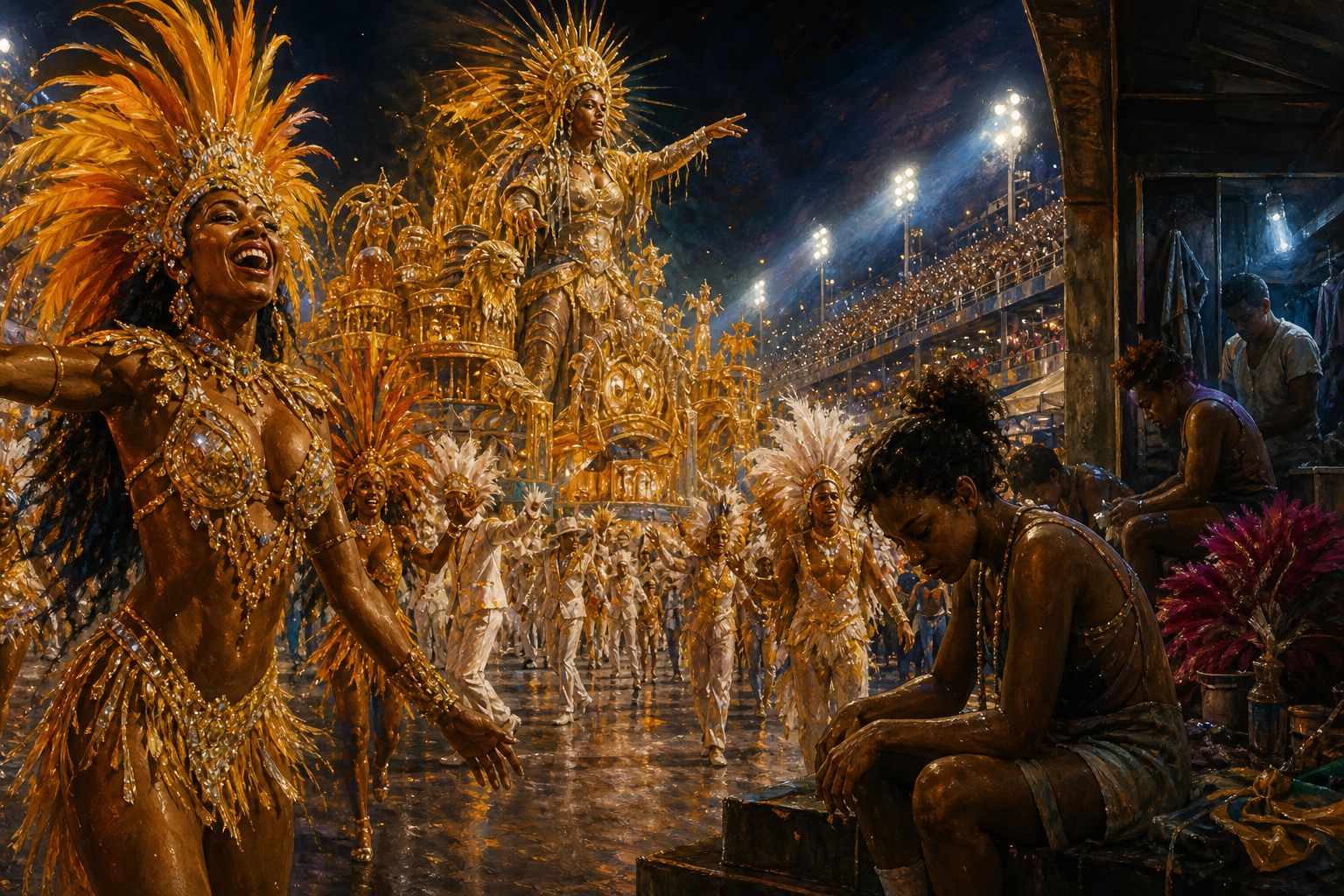
When millions of people are getting drunk and partying on the streets, why is there a group of people risking their lives on the parade avenue for 0.1 points, and even crying in despair upon learning of their relegation?
Because for them, this competition is not a “show,” but the livelihood, dignity, and future of the entire community.
The Truth of the Sambadrome: This Is a Deduction-Based Extreme Competition
You might think that the parade on the Sambadrome is just a group of people dancing in gorgeous costumes.
But the parade on the Sambadrome is actually a national event with 10 major judging criteria, a lowest-score elimination mechanism, and a professional jury that grades in isolation.
The judging on the Sambadrome is not about ‘who is the most beautiful’, but a deduction game of ‘finding flaws’.
No Judging of Aesthetics, Only ‘Did They Make Mistakes’
Months before the competition, each samba school must submit a thick, dictionary-like ‘Script Bible’—the parade specification manual—to the jury. It records in detail the design of each float, the material of each costume, and every single metaphor in the lyrics.
When grading, the judges hold this manual and check item by item:
- The manual says the float will spray water; did it spray water on site? Yes, no deduction.
- The manual says dancers wear blue fish-scale costumes; did anyone wear the wrong color? No, no deduction.
- Torn clothes or dropped accessories? Sorry, direct deduction of 0.1 to 0.2 points.
The role of the judge is not an “art critic,” but a “quality control auditor.”
10 Major Judging Criteria: What on Earth Is Being Tested?
Think of the Sambadrome as an “action Broadway opera” performed by 4,000 people simultaneously on a 700-meter runway. Here are the subjects that the judges are testing under a magnifying glass:
| Judging Criteria | What Are They Judging? |
|---|---|
| Drum Section (Bateria) | Rhythm control and percussion performance. Did 200 to 300 drums blend into a single voice? Is there a stunning, self-created variation? |
| Samba Song (Samba-Enredo) | Lyric meaning and musical melody. Do the lyrics perfectly fit the theme? Is the melody so catchy that tens of thousands of people in the audience can sing along? |
| Harmony (Harmonia) | The perfect coordination between singing, drumming, and dancing steps. Are all 4,000 performers singing loudly? If anyone lip-syncs, points are deducted. |
| Evolution and Flow (Evolução) | The rhythm, formation changes, and smoothness of the procession. Is the speed of movement uniform? Are there any gaps (“Buraco”) in the front or back? |
| Theme Narrative (Enredo) | The structure and presentation of the entire team’s story. Do the floats and costumes tell the story clearly? Judges will compare page by page with the script. |
| Front Commission (Comissão de Frente) | The opening performance and choreography at the very front of the procession. A group of 10 to 15 performers with acrobatic dances, usually with explosive props or mechanisms. |
| Floats and Decors (Alegorias e Adereços) | The design, creativity, and visual impact of the floats. Craftsmanship precision, whether mechanisms malfunction—one burnt-out light bulb results in a deduction. |
| Costumes (Fantasias) | The craftsmanship of the clothes. If accessories fall on the runway and are picked up, points are deducted. |
| Flag Bearer and Escort (Mestre-Sala & Porta-Bandeira) | The poise and performance of the core couple waving the school flag. Soul-stirring couple dance; if the flag lady falls or the flag gets wrapped, they are basically out of the championship run. |
| Highlights and Features (Destaques) | The visual presentation of spotlight figures on the floats or in the procession. |
Cruel Details: 0.1 Points Can Determine Life or Death
Drum Section is the “engine” of this giant parade race car.
If the drummers’ rhythm is fast and slow, the thousands of people behind them will instantly descend into chaos, like a pile-up highway accident.
Costumes are not about who wears the sexiest outfit.
Suppose this year’s theme is ‘The History of the Brazilian Coffee Battle’; the first wing’s costume should represent the green of natural coffee beans, and the second wing should express the blood and tears of slave harvesting.
If it is hard for people to understand what it has to do with the theme, points will be severely deducted.
Why Make It So Strict?
If the judging were canceled today, everyone would save money by just playing Western EDM and wearing bikinis to twist a bit on the street.
Within a few years, traditional Brazilian samba culture would be completely swallowed by commercial trends.
The judging system is the ‘hard breakwater’ of Brazilian culture, forcing everyone to achieve the extreme of art and history while getting drunk and partying.
| Without Judging | With the Judging System |
|---|---|
| Music shifts toward cheap pop | Forced to flip through historical archives and study African mythology |
| Visuals rapidly homogenize | Representing cultural depth with the highest standards |
| Just a huge nightclub scene | Becoming a ‘Cultural Olympics’ with an annual output of billions of dollars |
| Corporations don’t sponsor, TVs don’t broadcast | A super event with suspense, winners, losers, and dramatic tension |
Promotion and Relegation: A Devastating Disaster Involving Livelihood
The system of the Sambadrome is entirely inherited from the football league. The highest tier is called the ‘Special Group’, with only 12 teams.
Every year, the last-placed team is relegated, and the first-placed team from Group A is promoted.
The Chain Reaction of Relegation
| Impact | Description |
|---|---|
| Direct Financial Bankruptcy | The TV broadcast royalties, government subsidies, and ticket share of the Special Group plunge by 70% to 80% instantly upon relegation to Group A. |
| Sponsors Flee in Mass | Large corporations only want to paste their logos on the floats of the Special Group; relegation means the contract becomes waste paper. |
| Mass Exodus of Top Talents | Star directors, chief drummers, and choreographers will be headhunted by other schools with high salaries the next day. |
| Cleaners and Carpenters Out of Work | The school has no budget, leaving tailors, carpenters, and cleaners without work for the entire year. |
Relegation is not just the loss of a game, but the economic collapse of the entire favela community.
At the ‘Ballot Counting Assembly’ on the last day of Carnival, you will see tens of thousands of people crying in despair or joy when they hear their school is ‘saved’ or ‘unfortunately relegated.’
For them, this is more of a matter of life and death than the Football World Cup.
The Ultimate Voice Stage of the Favela
The roots of these samba schools are all in the Favela (slum) where public order is bad and resources are scarce.
For the residents, the Sambadrome is their only opportunity in a year to ‘rely on talent to turn their lives around’.
Defeating Class with Talent
Cleaners who usually sweep in luxury villas and mechanics who repair cars on the street will put on the most dazzling costumes during Carnival, standing on top of the floats to receive the cheers of tens of thousands.
The wealthy and politicians who are usually high above can only sit in the audience and applaud the talent of the grassroots commoners.
Social Movement Under the Gorgeous Cover
The parade themes of samba schools are never easy. They bring issues that society “knows but chooses to ignore” onto the stage of global broadcasting:
- The true history of Brazilian slave liberation
- The memorial of a politically assassinated city councilor
- The dignity and pride of favela residents
- The discriminated African-Brazilian religious culture
In this performance, they are not only performers, but also protesters.
Carnival is not just a collective party, it is a social movement.
Seeing the Cry of Life Behind the Feathers
The next time you see the broadcast of the Brazilian Carnival on TV, don’t just see those gorgeous feathers and brilliant smiles.
Those people dancing desperately on the avenue are, in many cases, just workers earning the minimum wage during the day.
They spent a whole year sacrificing their nights, weekends, and holidays to rehearse, gambling on the dignity and future of the entire community.
This is not a show; this is a social movement woven with blood, tears, and talent—it is the cry of their lives.
Reference
- Understand the Rio Samba Parade in One Article: What Is a “Samba School”? Whose Blood and Tears Are Behind the Revelry? | York / Nan De Mei Li | Crossing
- Brazil Carnival Guide: Five Days and Four Nights of National Celebration, Walking the Streets, Feeling the Most Authentic Carnival Spirit | York / Nan De Mei Li | Crossing
- What Is the World’s Largest Brazilian Carnival? Origin, Scale, and the Truth Behind the Participation of 7 Million People
- A Must-Do Life Bucket List in Brazil! 65 Million People Partying Together Until 5 AM! - YouTube
- (Brazil) Kiss Whoever You Want! Breaking into the World’s Most Open Street Party! The Various Crazy and Out-of-Control Behaviors Behind the Street Carnival of Millions!? - YouTube