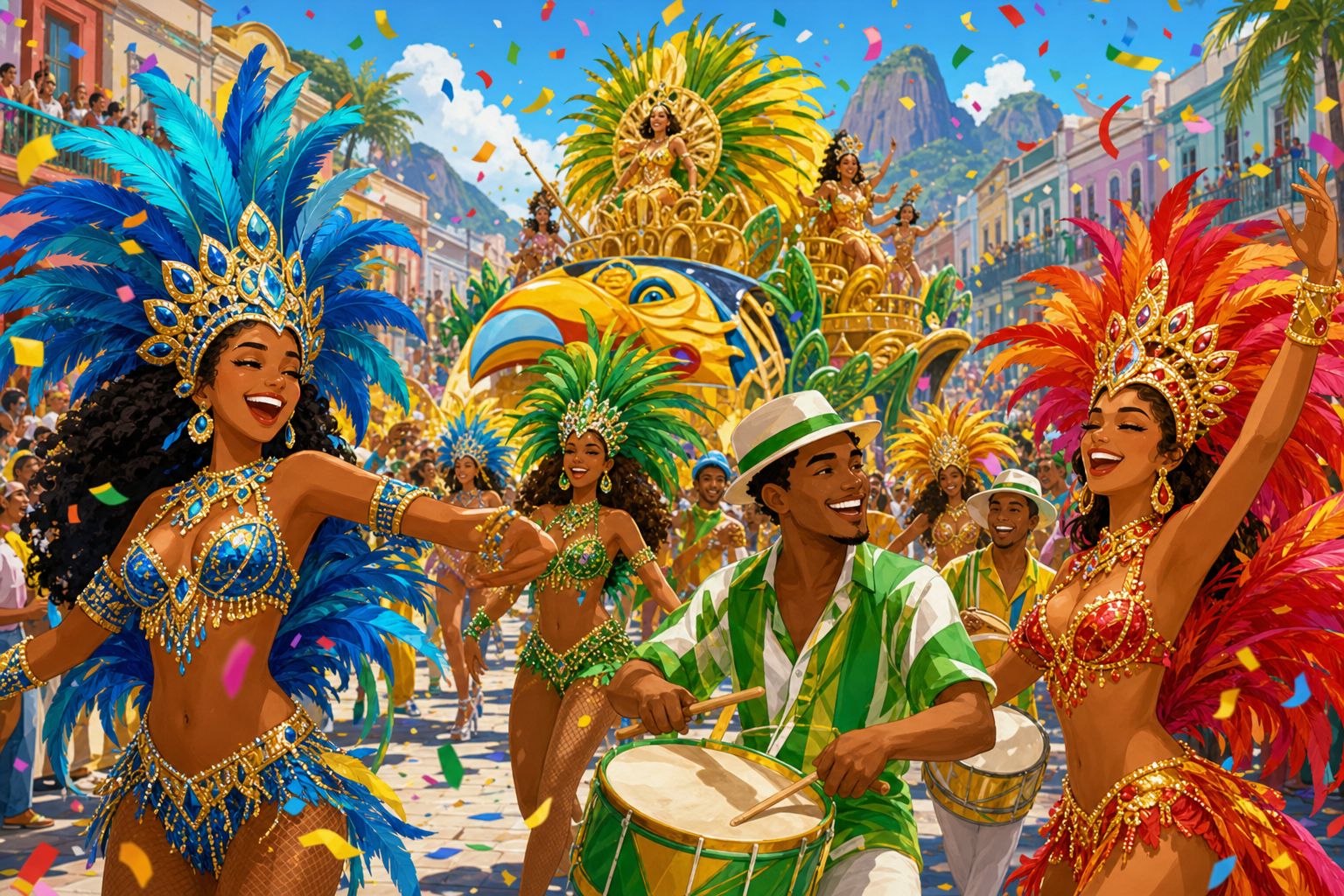
When you see Brazil Carnival on TV, is it always just a bunch of dancers in colorful feathers dancing the Samba?
In fact, that is just the tip of the iceberg. The real Brazil Carnival is two completely parallel worlds running at the same time: one is the top-tier national competition which requires a high entrance fee, and the other is the open-air street party where millions of people celebrate for free.
Sambadrome: Not a Show, but a National Competition of Pride
Many people think the parades in the Sambadrome (Sambódromo) are just a fancy show, but it is actually a brutal survival battle.
The Sambadrome Parade is not a simple performance, but a national competition with a strict scoring system similar to F1 racing.
What is a Samba School?
The name “Samba School (Escola de Samba)” sounds like a place to learn skills, but it is actually more like a “local community center”.
Most members of a “Samba School” come from nearby underprivileged neighborhoods. They are mechanics, cashiers, or office workers by day, and practice without pay all year long, just for that one night of glory at Carnival.
| Item | Description |
|---|---|
| Team Size | 3,000 to 5,000 people per school |
| Floats | 5 to 8 giant floats, some three stories high |
| Drum Section | A professional drum section of 200 to 300 drummers |
| Performance Time | Must complete the 700-meter route within 60 to 75 minutes |
| Prep Time | A whole year of preparation for just one single parade |
Extreme Competition Behind the Glamour
How brutal is this competition? Each school has a “parade specification manual” that is hundreds of pages thick, and judges will evaluate them line by line based on this manual.
They don’t judge if it “looks good,” but rather “if any mistakes were made”:
- Is the drummers’ tempo unstable? Points deducted.
- Did an outfit accessory fall onto the track? Points deducted.
- Are there gaps between different groups? Points deducted.
- Did someone fail to sing out loud? Points deducted.
The school in last place will be demoted, and demotion means loss of sponsorships, waves of unemployment in the community, and a whole year of hard work in the favela going down the drain.
Street Parties: Free, Wild, and Open to Everyone
If the Sambadrome is the “Super Bowl,” then the Street Parties (Blocos) are the Brazilian version of “Songkran” (Water Festival), except replacing the water with beer and music.
Seemingly Random, but Follows a Strict Script
Every street party follows a precise three-act script:
| Phase | What Happens | What You Should Do |
|---|---|---|
| Assembly | A massive sound truck parks at a fixed intersection; the band tunes up | Buy a beer, apply glitter, and gather with friends |
| Parade | The truck moves forward at a slow 2 km/h; tens of thousands follow and dance | Put away your phone, and jump up and down to the rhythm |
| Dispersal | The truck reaches the finish line; the sound system snaps off | Head home (street sweepers immediately begin cleaning) |
The Brazilian government launches an official “Carnival App” every year, which lists the schedules and route maps for hundreds of parties across the city.
At its peak, Rio can have more than 100 street parties erupting on different corners in a single day.
Before Joining the Party, Understand These Cultural Red Lines
If you want to have a blast without getting into trouble, there are a few lines you must never cross.
Absolute Respect for the Samba School Flag
If you see a Flag Bearer (Porta-Bandeira) carrying the school flag in the parade, do not touch that flag under any circumstances.
To the favela residents, that flag is as sacred as the statue of a patron saint to local churchgoers.
Red Lines for Costumes
Dressing up as Super Mario, a unicorn, or a hot dog is totally fine, but the following are strictly prohibited:
- Blackface
- Costumes that mock indigenous people or Afro-Brazilian religions
- Any costume with racist undertones
Physical Boundaries Are Absolute
The Brazilian Carnival has a “Não é Não” (No Means No) campaign.
No matter how high the energy is, the moment the other person shakes their head or pushes you away, you must turn and leave immediately.
The crowd and the police have zero tolerance for non-consensual behavior.
Practical Survival Guide: Don’t Be an Easy Target
The streets during Carnival are the annual “Olympic Games” for pickpockets worldwide.
| Item | Advice |
|---|---|
| Shoes | You must wear closed-toe shoes (old sneakers are best); the ground is covered in broken glass and mysterious liquids |
| Phone | Do not put it in your pockets, and do not hold it up in the crowd to record videos |
| Wallet | Buy a Doleira (hidden money belt) and wear it flat against your skin under your clothes |
| Cash | Only bring enough cash for buying beer and getting a ride back to the hotel that day |
| Outfit | The less fabric and the more breathable, the better; be ready to throw it away after Carnival |
Five Days and Four Nights, Whatever You Want, Carnival Has It
Want to see humanity elevate revelry to the highest temple of art? Go to the Sambadrome, and watch thousands of people risk their lives for dignity and a fraction of a point.
Want to dance with millions of strangers on the street without holding back? Go to a Street Party, buy a cold beer, follow that deafening sound truck, switch off your brain, and just dance.
The charm of Brazil Carnival lies in:
The government uses the strictest regulations to plan routes and schedules, so that within those boundaries, people can enjoy absolute freedom.
Smile at the person next to you on the street, say “Tudo bem?” (How is everything?), and just dance.